

"Natural retinol" is a marketing phrase, not a chemical category. Bakuchiol has real clinical evidence as a retinoid alternative: one well-designed trial showed it produced comparable visible results to retinol with better tolerability. Rosehip oil contains trace trans-retinoic acid at concentrations far below pharmaceutically relevant levels; it is a nourishing carrier oil, not a meaningful retinoid. Retinyl palmitate is the gentlest cosmetic vitamin A, it converts through the same enzymatic pathway to retinoic acid, but it is a synthesised ingredient, not a natural plant extract. Each of these ingredients has real value. None of them deserve to be sold under a phrase that implies they do what pharmaceutical retinol does.
If you have spent time in natural skincare communities, you have almost certainly encountered the phrase "natural retinol." It appears on bottles of bakuchiol serum, rosehip oil, and vitamin A products in botanical bases. It sounds helpful. It is, in practice, imprecise enough to be misleading.
Three quite different ingredients get called by this name, and they work through three quite different mechanisms. Grouping them under a single marketing phrase does not serve the women who are actually trying to understand what they are putting on their skin and what to expect from it.
Witchy's Retinyl Renewal Oil uses retinyl palmitate in a botanical carrier base. We do not describe it as "natural retinol" because we do not think the phrase is accurate. This article is the fuller explanation of why, and of what each of these three ingredients actually is.

What "natural retinol" actually means in marketing
The phrase gets used in three distinct ways, each with its own logic and its own limitations.
The first is bakuchiol. This is the most defensible use. Bakuchiol is a plant-derived compound that influences some of the same gene-expression pathways as retinoids, and it has published clinical evidence to support its use as a retinoid-adjacent ingredient. When bakuchiol products are called "natural retinol," the implication is functional similarity. The research supports a degree of that similarity, with important caveats about the narrowness of the evidence base.
The second is rosehip oil. This is the least defensible use. Rosehip oil contains trace amounts of trans-retinoic acid, which is technically a retinoid. The "natural retinol" label follows from this fact. The problem is that the concentration is several orders of magnitude below what produces pharmacological retinoid activity. Calling rosehip oil a natural retinol because it contains trace trans-retinoic acid is a bit like calling green tea a "natural caffeine pill" because it contains caffeine. True in the strictest sense. Misleading in every practical sense.
The third is retinyl palmitate sold in a botanical base. The framing here is that retinyl palmitate is the form your body stores vitamin A in naturally, so it is somehow more natural than other vitamin A forms. There is a grain of truth here too. But retinyl palmitate is a synthesised cosmetic ingredient; it is not extracted from plants. Witchy's Retinyl Renewal Oil uses retinyl palmitate. We do not describe it as natural retinol because we do not think the phrase is accurate.
The common thread across all three uses: the phrase does more work than the science supports. Women who are researching gentler options for ageing skin, often after experiences of reactivity with stronger retinoids, deserve clarity rather than a marketing shortcut.
Bakuchiol, clearly explained
Bakuchiol is a meroterpene phenol derived from the seeds and leaves of Psoralea corylifolia, a plant used in traditional Ayurvedic and Chinese medicine. It has been studied in cosmetic science since the mid-2000s, and the foundational work by Chaudhuri and Bojanowski in 2014 established that it influences gene-expression pathways associated with collagen synthesis and cell turnover in ways that overlap with retinoid activity [1]. Structurally, it has nothing in common with vitamin A. Functionally, some of its downstream effects resemble retinoid effects. This is why it sits in its own category.
The study most frequently cited in bakuchiol marketing is the Dhaliwal et al. 2019 trial published in the British Journal of Dermatology [2]. This was a prospective, randomised, double-blind study: 44 women, comparing 0.5% bakuchiol applied twice daily against 0.5% retinol applied once daily over 12 weeks. The primary endpoints were standardised photography assessments of wrinkles and hyperpigmentation. Both groups showed significant visible improvements from baseline. The improvements were statistically comparable between groups. The bakuchiol group reported significantly less facial scaling and stinging. This is a well-designed trial and its findings are meaningful.
The caveats are worth stating clearly. Forty-four participants is a small sample. The dosing protocol was not equivalent: bakuchiol twice daily versus retinol once daily is not a head-to-head of identical conditions. The 12-week timeframe captures early change but not the long-term accumulation that is often where the bigger visible difference emerges with retinoids. Bluemke et al. in 2022 expanded the mechanistic picture and supported bakuchiol's activity at the molecular level, but the human clinical evidence base remains narrower than for retinyl palmitate, which has decades of cosmetic research behind it [3].
Witchy does not currently make a bakuchiol product. That is a considered choice, not an oversight. Retinyl palmitate has a longer research history and a conversion pathway we understand well. Bakuchiol is the most credible "natural retinol" candidate in the market. If that is what you are looking for, the evidence is real, and the Dhaliwal study is a genuinely useful piece of research.
"In a twelve-week split-face trial, 0.5% bakuchiol twice daily produced visible improvements in the appearance of wrinkles and hyperpigmentation that were statistically comparable to 0.5% retinol once daily, with significantly less scaling and stinging."Dhaliwal et al., British Journal of Dermatology, 2019 [2]
Rosehip oil, clearly explained
Cold-pressed rosehip oil is extracted from the seeds of several Rosa species: most commonly Rosa canina, Rosa rubiginosa, and Rosa moschata. Its fatty acid profile is well-established: high in linoleic acid and alpha-linolenic acid, with oleic acid, tocopherols, carotenoids, and, crucially, trace amounts of trans-retinoic acid [4] [5].
That trace trans-retinoic acid is the reason rosehip oil gets called "natural retinol." Trans-retinoic acid is the active form of vitamin A that binds directly to retinoid receptors. In that sense, rosehip oil contains the most potent retinoid form of all. The problem is concentration. The trans-retinoic acid in rosehip oil is present at concentrations several orders of magnitude below the levels required for pharmacological retinoid activity. Pharmaceutical tretinoin, which is pure trans-retinoic acid, is prescribed at concentrations of 0.025% to 0.1%. The trans-retinoic acid in rosehip oil is present at fractions of a fraction of that level. The retinoid activity is not clinically meaningful at these concentrations.
What rosehip oil is genuinely good for is substantial, and it does not require inflated claims. The linoleic acid content supports the skin barrier; linoleic acid-deficient skin tends toward increased sensitivity and impaired barrier function, and topical linoleic acid helps address this [4]. The tocopherols provide antioxidant activity. The overall sensory profile, light, absorbing, non-comedogenic in most skin types, makes it a useful carrier for other actives. It has a calming feel on reactive skin.
Witchy uses rosehip oil in the carrier base of the Retinyl Renewal Oil for these real properties. Not for retinoid activity. The formulation is honest about what rosehip oil contributes: barrier support, antioxidant activity, a sensory experience that makes the oil pleasant to use. That is genuinely valuable. It does not need to be dressed up as something it is not.
Retinyl palmitate and the "natural retinol" framing
The third use of "natural retinol" is the closest to accurate, and still needs unpacking.
Retinyl palmitate is an ester of retinol (vitamin A alcohol) and palmitic acid, a saturated fatty acid. It is synthesised in laboratory conditions from these two components, some versions of which may themselves be derived from plant or animal sources. The finished ingredient is manufactured. It is not extracted from a plant as a whole compound.
The "natural" framing comes from one real fact: retinyl palmitate is the form in which your body stores vitamin A. The liver stores vitamin A primarily as retinyl esters, predominantly retinyl palmitate. Skin contains small reserves of retinyl esters. In that physiological sense, retinyl palmitate is the form closest to what the body handles naturally. This is a meaningful piece of biology, and it is part of why retinyl palmitate is so well tolerated.
But it does not make the cosmetic ingredient "natural" in the way that a cold-pressed plant oil is natural. Retinyl palmitate converts to retinoic acid through three enzymatic steps: ester hydrolysis to retinol, oxidation to retinaldehyde, and irreversible oxidation to retinoic acid [6]. Each step is gradual. The gentleness of retinyl palmitate follows directly from this pathway: at any moment, only a small fraction of the applied ingredient has reached the active retinoic acid form. The receptor binding is gradual. The cellular response is gradual. This is an asset for reactive skin, for skin in perimenopause, for anyone who wants to use a vitamin A product without the initial irritation phase that stronger retinoids often require.
We use retinyl palmitate and we do not call it natural retinol. The ingredient is real, the gentleness is real, and the conversion pathway is real. The marketing phrase adds nothing and obscures quite a lot.
What this means for choosing a product
Stripped of the marketing phrases, the practical picture looks like this.
Retinyl palmitate is the gentlest cosmetic vitamin A. It is the choice for reactive skin, for skin in perimenopause that has become more sensitive, for anyone who has reacted to stronger retinoids and wants to try vitamin A again from the gentlest starting point. It is slower to produce visible change than retinol or retinaldehyde, and more consistent use over many months matters more than intensity. The Retinyl Renewal Oil is what Witchy makes in this category.
Bakuchiol is plant-derived, structurally unrelated to vitamin A, and the most evidence-supported non-vitamin-A option for visible skin ageing. The Dhaliwal 2019 trial [2] is a genuinely useful piece of research. The evidence base is narrower than for retinyl palmitate, but the tolerability profile is strong. It is a reasonable choice for skin that reacts to all vitamin A forms.
Rosehip oil is a nourishing carrier oil with barrier-supporting and antioxidant properties. It is not a retinoid substitute. It pairs usefully with retinoids because its fatty acid profile and sensory properties support the skin during the adjustment period. Expecting it to perform retinoid functions will lead to disappointment.
Niacinamide is not usually grouped with these three, but it deserves a mention here. It has strong clinical evidence for improving the appearance of enlarged pores, uneven skin tone, and fine lines, and it pairs well with retinoids. If you are looking for a starting point that is not a retinoid at all, niacinamide plus bakuchiol is a well-tolerated combination with meaningful evidence behind both ingredients.
If your skin reacts to all forms of vitamin A, the evidence-supported path is bakuchiol combined with niacinamide, with rosehip oil as a supporting carrier rather than an active.

Retinyl Renewal Oil
The gentlest cosmetic vitamin A, in a botanical carrier base that includes rosehip oil, used for its real properties, not its marketing ones.
See the Retinyl Renewal OilWhy Witchy chose retinyl palmitate
Three reasons, each considered.
First, the research base. Retinyl palmitate has decades of cosmetic research behind it. The conversion pathway is well understood at the enzymatic level. The tolerability profile is established across a wide range of skin types. When we were formulating the Retinyl Renewal Oil, we wanted an active with a track record long enough to trust.
Second, the conversion pathway. The three-step conversion from retinyl palmitate to retinoic acid is gradual, predictable, and enzyme-dependent. It is not subject to the same oxidative instability that makes retinol difficult to formulate. In an oil-based product, retinyl palmitate is stable in a way that retinol is not. The formulation logic works.
Third, the audience fit. The women who find Witchy are often in perimenopause or beyond, often with a history of skin reactivity, often having tried and reacted to stronger retinoids. Retinyl palmitate is the right starting point for this skin. The Retinyl Renewal Oil is built specifically for it.
We may consider a bakuchiol product in the future. The evidence base is maturing and the tolerability story is compelling. For now, the product we make is the Retinyl Renewal Oil, and it is the product we stand behind.
We do not recommend any retinoid or retinoid-alternative ingredient during pregnancy or breastfeeding. Bakuchiol's safety in pregnancy is not established; the same precaution applies as for retinoids. If you have an active skin condition (eczema, rosacea, perioral dermatitis), hold any ageing-skin active until your GP is comfortable. For active cancer treatment, speak with your treating clinician before adding any new skincare active. healthdirect.gov.au and the Australasian College of Dermatologists A to Z of Skin are the AU resources.

I want to be careful with this article because I know how much of the natural skincare audience is genuinely trying to do the right thing. The women I hear from are not chasing trends. They are making careful choices, often after years of research, often via the natural-products route after real experiences of reactivity or sensitisation.
I respect this. It is close to my own approach. The clean-beauty audience is not silly. It is discerning, and it deserves precise language. "Natural retinol" is marketing. It is not chemistry. The ingredients sold under that label are, mostly, real ingredients with real properties. They just deserve clearer claims than the phrase usually gives them. If you want a vitamin A product, retinyl palmitate is the gentlest option, and Witchy makes one I put on my own face. If you want a non-vitamin-A approach, bakuchiol is the most evidence-supported choice. If you have been using rosehip oil and feeling it should be doing more: the honest answer is it does real things, nourishing, antioxidant, barrier-supporting things, but it does not do retinoid things.
Common questions
Is rosehip oil really natural retinol?
No. Rosehip oil contains trace amounts of trans-retinoic acid, which is technically a retinoid, but the concentration is several orders of magnitude below what produces pharmacological retinoid activity. Calling rosehip oil a natural retinol on the basis of this trace content is technically true and practically misleading. Rosehip oil is a genuinely useful nourishing carrier oil. It is not a retinoid substitute.
Is bakuchiol as effective as retinol?
One well-designed trial (Dhaliwal et al., 2019) found that 0.5% bakuchiol twice daily produced visible improvements in the appearance of wrinkles and hyperpigmentation that were statistically comparable to 0.5% retinol once daily, with significantly better tolerability. The evidence base is narrower than for retinol or retinyl palmitate, and the study used different dosing protocols for each ingredient, so a strict head-to-head comparison is not possible. The findings are promising, and the tolerability story is strong.
What is the difference between bakuchiol and retinol?
They are structurally unrelated. Retinol is vitamin A alcohol, a fat-soluble compound that converts in the skin to retinoic acid and binds to retinoid receptors. Bakuchiol is a meroterpene phenol from Psoralea corylifolia; it has no structural similarity to vitamin A but influences some of the same gene-expression pathways through a different mechanism. They are not interchangeable, but their downstream effects on visible skin ageing show overlap in the existing evidence.
Is retinyl palmitate natural?
No, not in the way a cold-pressed plant oil is natural. Retinyl palmitate is a synthesised cosmetic ingredient: an ester of retinol and palmitic acid, manufactured in laboratory conditions. The "natural" framing comes from the fact that retinyl palmitate is the form in which the body stores vitamin A. This is a real piece of biology. It does not make the cosmetic ingredient a plant extract.
Can I use bakuchiol during pregnancy?
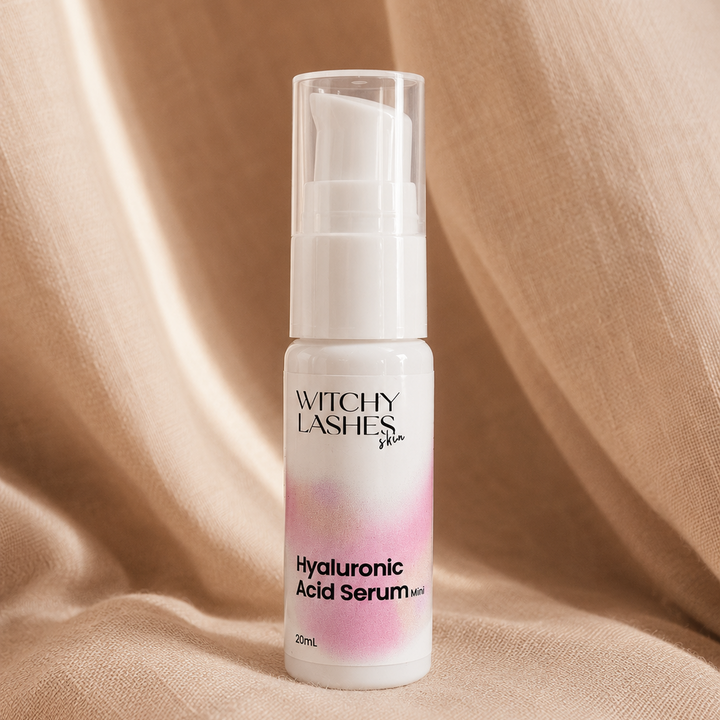
Bakuchiol's safety in pregnancy is not established. We apply the same precaution to bakuchiol as to retinoids: we do not recommend it during pregnancy or breastfeeding. The Witchy Hyaluronic Acid Serum is a calmer option for this window. Please speak with your GP, obstetrician, or midwife.
Can rosehip oil and retinol be used together?
Yes, and it is a useful combination. Rosehip oil's barrier-support and antioxidant properties complement retinoids well. The fatty acid profile helps maintain skin comfort during the adjustment period. Witchy's Retinyl Renewal Oil has rosehip oil built directly into the carrier base: the formulation uses rosehip for these real properties, alongside the retinyl palmitate active.
What is the best "natural retinol" alternative?
Bakuchiol has the strongest clinical evidence as a non-vitamin-A option for visible skin ageing (Dhaliwal et al., 2019). Niacinamide also has strong evidence for similar concerns (pore appearance, uneven tone, fine lines) and pairs well with both retinoids and bakuchiol. Rosehip oil is a useful supporting ingredient with real barrier and antioxidant properties, but it is not a retinoid alternative in any meaningful sense.
Why doesn't Witchy make a bakuchiol product?
The evidence base for bakuchiol is more recent and narrower than for retinyl palmitate. When we were formulating the Retinyl Renewal Oil, we chose retinyl palmitate because its research history is longer, its conversion pathway is well understood, and it matched what the audience we were building for actually needed. We may consider a bakuchiol product in the future as the evidence base matures. The current Witchy product in this category is the Retinyl Renewal Oil.
The Renewal Ritual
Retinyl Renewal Oil paired with the Hyaluronic Acid Serum and the Blue Tansy Calming Facial Oil: the three-step routine built for skin in perimenopause and beyond.

Where to next
References
- Chaudhuri RK, Bojanowski K. Bakuchiol: a retinol-like functional compound revealed by gene expression profiling and clinically proven to have anti-ageing effects. International Journal of Cosmetic Science. 2014.
- Dhaliwal S, et al. Prospective, randomised, double-blind assessment of topical bakuchiol and retinol for facial photoageing. British Journal of Dermatology. 2019.
- Bluemke A, et al. Bakuchiol: emerging new approaches for skin anti-ageing. International Journal of Cosmetic Science. 2022.
- Lin T-K, et al. Anti-inflammatory and skin barrier repair effects of topical application of some plant oils. International Journal of Molecular Sciences. 2017.
- Mármol I, et al. Rosehip: an underestimated functional food with valuable technological and bioactive properties. International Journal of Molecular Sciences. 2017.
- Babamiri K, Nassab R. Cosmeceuticals: the evidence behind the retinoids. Aesthetic Surgery Journal. 2010.

