

Retinyl palmitate is the gentlest form of vitamin A used in skincare, an ester of retinol and palmitic acid that skin converts in three slow steps into retinoic acid. It is related to retinol, not the same thing: retinol sits one step further along that path, which is why retinyl palmitate feels gentler but takes longer to show results.
Most articles about vitamin A start with the strongest form and work backwards. This one starts with the gentlest, because that is where the largest group of women we hear from actually needs to start.
Retinyl palmitate is the form of vitamin A your body already stores. It is the form most likely to be tolerated by sensitive or reactive skin. It is also the most honest place to have the conversation about what vitamin A can and cannot do, because the evidence for retinyl palmitate is more nuanced than for retinol or retinaldehyde, and nuance is where real understanding lives.

What is retinyl palmitate?
Retinyl palmitate is the formal name for retinol palmitate: an ester of retinol (vitamin A alcohol) and palmitic acid, a saturated fatty acid that occurs naturally in palm oil, dairy, and human sebum.
Esters are common in skincare. They are more stable than free alcohol forms of an ingredient, more tolerable on the skin, and easier to formulate into oil-based products. Retinyl palmitate benefits from all three of those properties.
It is also the form of vitamin A your body stores in its own tissues. The liver stores vitamin A primarily as retinyl palmitate, and skin contains small reserves of retinyl esters. The cosmetic ingredient is, in that sense, a topical version of the form your body already uses for vitamin A storage.
One point worth stating clearly: retinyl palmitate in skincare is a synthesised cosmetic ingredient. Even when some of its components, particularly palmitic acid, can be plant-derived, the finished ingredient is manufactured rather than extracted from a plant whole. The phrase "natural retinol" is sometimes applied to it, but we do not use that phrase because we do not think it is accurate. Retinyl palmitate is gentle. It is not natural in the way unprocessed plant oils are natural.
What happens when you apply it to your skin
The conversion pathway from retinyl palmitate to retinoic acid involves three enzymatic steps, each of which has been studied in detail.
When you apply retinyl palmitate to skin, esterase enzymes begin hydrolysing it into retinol and free palmitic acid. The retinol is then oxidised by alcohol dehydrogenase enzymes into retinaldehyde. The third and final step, oxidation of retinaldehyde into retinoic acid by aldehyde dehydrogenase enzymes, is irreversible. Retinoic acid then binds to retinoid receptors in skin cells and influences the genes that affect cell behaviour, structural protein synthesis, and skin surface renewal.
The three-step pathway is the mechanistic explanation for why retinyl palmitate is so well tolerated. At any given moment, only a small fraction of the applied retinyl palmitate has reached the retinoic acid form. The conversion is gradual, the receptor binding is gradual, and the cellular response is gradual. A 2024 study measuring conversion rates in a three-dimensional human skin model found that retinyl palmitate produced retinoic acid more slowly and at lower peak concentrations than retinol or retinaldehyde, and had the lowest impact on skin barrier integrity of the three forms tested [1].
The Witchy Retinyl Renewal Oil uses retinyl palmitate in a botanical carrier base, paired with rosehip oil and other plant oils that support the skin barrier through the conversion process. The carrier is not decoration: it is formulation logic.
What the research actually shows
The peer-reviewed picture for retinyl palmitate requires honesty on both sides of the ledger.
The strongest evidence is mechanistic. Research confirms that retinyl palmitate, after conversion to retinoic acid, influences the same cellular pathways as other retinoids. The biological activity is real. What varies is the concentration of retinoic acid produced and how quickly it is produced.
A 2023 study in Frontiers in Pharmacology demonstrated that retinyl palmitate reduced UVB-induced collagen degradation in murine skin, reduced the expression of inflammatory markers IL-6, IL-1 and TNF, improved cell migration in wound assays, and produced dose-dependent reductions in the appearance of wrinkles and erythema in UV-irradiated skin [2]. This is the most comprehensive single study of retinyl palmitate's anti-photoageing activity.
A 2010 study in the British Journal of Dermatology examined a cosmetic formulation containing niacinamide, peptides, and a retinyl ester (retinyl propionate, a close structural cousin of retinyl palmitate) compared with prescription tretinoin 0.02% over twenty-four weeks. Both produced significant improvements in the appearance of wrinkles, with the cosmetic formulation showing better tolerability and a comparable magnitude of change [3]. This is meaningful: a retinyl ester in a well-formulated product produced results close to a prescription retinoid at a lower tolerability cost.
The most effective cosmeceutical vitamin A derivative is retinaldehyde. The review found no significant evidence to support retinyl palmitate as a solo cosmetic active.Babamiri & Nassab, Aesthetic Surgery Journal, 2010 [4]
We acknowledge this directly. The Babamiri and Nassab review is a real, peer-reviewed paper and its conclusion is real. It is one of the reasons we are careful in how we describe what the Retinyl Renewal Oil does. We do not claim retinyl palmitate matches the performance of retinaldehyde or tretinoin. We do claim, on the basis of the mechanistic evidence and more recent formulation research, that retinyl palmitate is a credible and tolerable option for skin that does not tolerate the stronger retinoids. Those are different claims, and both are supportable.
The photochemistry question, addressed directly
Some search results around retinyl palmitate include concerns about photodecomposition and reactive oxygen species formation under UV exposure. This deserves a direct answer, because women who research carefully will encounter it.
Several laboratory studies have shown that retinyl palmitate, when exposed to UV light in a solvent (not on skin), can generate reactive oxygen species. In 2012, the National Toxicology Program published a study of retinyl palmitate applied to hairless mice under simulated solar light, showing accelerated tumour development compared to controls. This study has been widely cited by consumer-health groups raising concerns about daytime use.
The dermatology community has formally responded. The consensus is that the hairless mouse model has known limitations as a predictor of human skin cancer risk, that the exposure conditions did not reflect typical cosmetic use, and that there is no clinical evidence of skin cancer risk from retinyl palmitate at concentrations used in cosmetic products.
The practical protocol is the same as for any retinoid: apply in the evening, use daily mineral sunscreen in the morning. This is not a special precaution for retinyl palmitate. It is the standard protocol for any vitamin A product. UV exposure also depletes vitamin A in the skin, which is another reason evening application makes biological sense [5].
Who retinyl palmitate suits
Retinyl palmitate is the right choice for several specific skin situations.
Skin new to vitamin A. Starting with retinyl palmitate and building over months is gentler on the barrier than starting with retinol or retinaldehyde. The conversion pathway means far less acute receptor activation.
Skin that has reacted to stronger retinoids. If retinol, retinaldehyde, or tretinoin have caused deep peeling, persistent redness, or burning that did not pass, retinyl palmitate is the most cautious next attempt. For reactive or easily irritated skin, the three-step conversion pathway makes a real difference.
Skin in perimenopause. As oestrogen shifts, the skin's tolerance for active ingredients often drops. The retinol that suited you at thirty-two may not suit you at forty-two. Retinyl palmitate is a reasonable recalibration.
Skin that wants consistency over intensity. Vitamin A works through accumulation. A retinoid you use four nights a week for a year will do more for the appearance of your skin than a retinoid you use seven nights a week for three weeks before reacting and stopping. The gentler option is the more consistent one.
Skin in a hot climate. Australian summer, with its UV and air-conditioning, is hard on retinoid-using skin. Retinyl palmitate's gentler profile is more forgiving in this kind of environment.

Retinyl Renewal Oil
Retinyl palmitate in a botanical carrier of rosehip oil and plant oils that support the skin barrier. Formulated for skin that wants consistent vitamin A without reactivity.
See the Retinyl Renewal OilWho should choose something else
Retinyl palmitate is not the right starting point for everyone.
If your skin has tolerated retinol or retinaldehyde well and you want more visible change in less time, a stronger retinoid is probably the right call. The gentleness of retinyl palmitate is an asset for sensitive skin, but it is slower for skin that can handle more.
If a dermatologist is treating you with prescription tretinoin for acne, photodamage, or melasma, follow the dermatologist's protocol.
If you have more established deep wrinkles and sun-related skin change, retinyl palmitate is unlikely to produce the level of change you may be looking for. Prescription tretinoin or in-clinic procedures may be more appropriate.
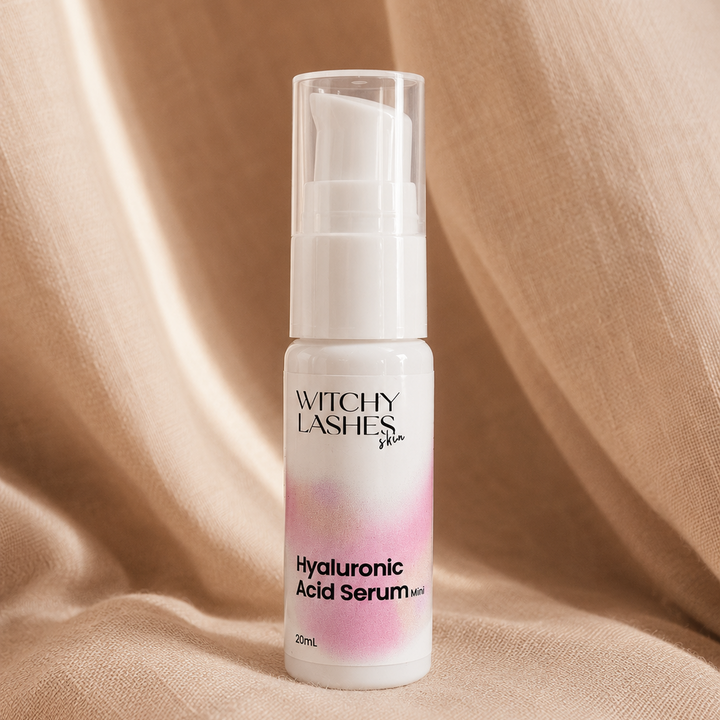
If you are pregnant or breastfeeding, no retinoid is recommended, including retinyl palmitate. The Witchy Hyaluronic Acid Serum on damp skin, sealed with a fragrance-free moisturiser, is the calmer option for this window. Please speak with your GP, obstetrician or midwife.
If you are in active cancer treatment, recovering from an in-clinic procedure, or managing a rosacea or eczema flare, speak with your treating clinician before starting any retinoid.
How to use it: a gentle protocol
If you have decided retinyl palmitate is the right starting point, the following protocol reflects what has worked for most women who have written to us about it.
Weeks one to two: settle your skin first. Before introducing the retinoid, run a calming baseline for two weeks. Gentle cleanser, hyaluronic acid serum on damp skin, Blue Tansy Calming Facial Oil as the seal step, sunscreen in the morning. If your skin is already reactive, settle it before adding the active.
Week three: introduce twice a week. Evening only. Gentle cleanser, hyaluronic acid serum on slightly damp skin, two to three drops of Retinyl Renewal Oil over the top, nothing else that night. No other actives.
Weeks four to six: build gradually. If comfortable, move to three nights a week, then four. Most women settle at four to six nights a week. There is no virtue in nightly use if your skin does not need it.
Off nights: calming routine. On non-retinoid evenings, hyaluronic acid serum on damp skin, Blue Tansy Calming Facial Oil over the top. This keeps your skin's water layer comfortable and gives the barrier its recovery window.
Sunscreen every morning. Non-negotiable. Australian UV is significant year-round and vitamin A increases UV sensitivity for at least twenty-four hours after application.
If your skin reacts to retinyl palmitate and the reaction does not settle within a week of stopping the product, see your GP. If you develop persistent redness, swelling, or a rash you have not had before, see your GP. If you have rosacea, eczema, or perioral dermatitis that flares after introducing the retinoid, pause and speak with your GP before reintroducing. If you are using a prescription retinoid and want to add a cosmetic vitamin A product, ask your prescribing doctor first. If you are pregnant, breastfeeding, or in active cancer treatment, this is a clinical conversation, not a skincare one. Resources: healthdirect.gov.au for plain-English guidance; the Australasian College of Dermatologists A-Z of Skin for AU specialist information.

A note from Marcha
When I was researching what to put into the Retinyl Renewal Oil, I read more papers on vitamin A than on any other ingredient I have worked with.
The thing that struck me most was the gap between what the scientific literature actually says and what most retinoid marketing claims. The literature is careful, hedged, full of "may", "in this population", "under these conditions". The marketing is loud, certain, often promising change in fourteen days.
I wanted to write the explanation I wished I had read when I was starting out. Retinyl palmitate is the gentlest member of the vitamin A family. It is not the strongest. It is not designed to give you the results that prescription tretinoin gives. What it can offer, when used consistently, with the right supporting routine, in skin that has been quietly waiting for a calm vitamin A option, can be genuinely useful.
Most of the women I have heard from over seven years of running Witchy are not looking for the most dramatic retinoid on the market. They are looking for something they can use consistently, on a face that has become more reactive in their forties, in the climate they actually live in. That is what we built the Retinyl Renewal Oil for.
Common questions
What is retinyl palmitate?
Retinyl palmitate is an ester of retinol (vitamin A alcohol) and palmitic acid. It is the gentlest cosmetic form of vitamin A available outside a prescription. Your skin converts it in three steps to retinoic acid, the active form that binds to retinoid receptors and influences cell behaviour. The three-step path makes it more tolerable and more stable than retinol or retinaldehyde, but also slower to produce visible change.
Is retinyl palmitate the same as retinol?
No, but they are related. Retinyl palmitate is an ester of retinol. When applied to skin, it first converts to retinol, then to retinaldehyde, then to retinoic acid. Retinol is one step further along the conversion path, which is why retinyl palmitate is gentler, and why it takes longer to produce visible change.
Does retinyl palmitate actually work?
The research base is mixed. Laboratory and animal studies show it has anti-photoageing activity through the same retinoid receptor pathway as other vitamin A forms. Human clinical evidence for retinyl palmitate as a solo active is weaker than for retinol or retinaldehyde, and one systematic review (Babamiri and Nassab, 2010) found insufficient evidence to support its use as a solo cosmetic active. More recent research suggests retinyl palmitate works well when paired with the right supporting ingredients in a well-formulated product.
How long does retinyl palmitate take to work?
For most skin, eight to twelve weeks for the first noticeable change in the look of fine lines, texture, or makeup application. Six months to a year for the bigger, more visible accumulated change. Retinyl palmitate works more slowly than retinol or retinaldehyde because it has further to travel through the conversion pathway. Consistency over many months matters more than intensity.
Is retinyl palmitate safe?
For cosmetic use on intact skin, yes. There is no clinical evidence of safety concerns at concentrations used in cosmetic products. The photodecomposition concerns raised in laboratory studies and an NTP animal study have been formally addressed by the dermatology community. The consensus is that evening application combined with daily sunscreen is the appropriate protocol. This applies to all retinoids, not just retinyl palmitate.
Can I use retinyl palmitate during pregnancy?
We do not recommend the Witchy Retinyl Renewal Oil during pregnancy or breastfeeding. Australian antenatal guidance is conservative about vitamin A derivatives, even topical ones. The clinical evidence is reassuring rather than alarming, but precaution remains the standard recommendation. Please speak with your GP, obstetrician, or midwife. The Witchy Hyaluronic Acid Serum is a calmer option for this window.
Is retinyl palmitate the same as "natural retinol"?
No. Retinyl palmitate is a synthesised cosmetic ingredient, even when some of its components can be plant-derived. "Natural retinol" is a marketing phrase, not a chemical category. We do not use it because it is not accurate.
Can I use retinyl palmitate with hyaluronic acid?
Yes, and the combination is gentle and well-tolerated. Hyaluronic acid on damp skin first, then the retinyl palmitate oil over the top a few minutes later. The hyaluronic acid draws water into the upper skin layers; the oil seals it in and delivers the retinyl palmitate. This is the routine we recommend for most women starting the Retinyl Renewal Oil.
The skin renewal trio
The three products referenced through this article: Hyaluronic Acid Serum, Blue Tansy Calming Facial Oil, and Retinyl Renewal Oil, in the order they are meant to be used.

Where to next
References
- Lee, J.H. et al. (2024). Comparative skin delivery and tolerability assessment of retinoid forms in a three-dimensional human skin model. International Journal of Pharmaceutics.
- Shu, Y. et al. (2023). Retinyl palmitate attenuates UVB-induced photoageing through modulation of inflammatory cytokines and collagen degradation. Frontiers in Pharmacology.
- Fu, J.J. et al. (2010). A randomised, controlled comparative study of the wrinkle reduction benefits of a cosmetic niacinamide/peptide/retinyl-propionate product regimen versus a prescription 0.02% tretinoin product regimen. British Journal of Dermatology, 162(3), 647–654.
- Babamiri, K., & Nassab, R. (2010). Cosmeceuticals: the evidence behind the retinoids. Aesthetic Surgery Journal, 30(1), 74–77.
- Antille, C. et al. (2003). Topical vitamin A (retinol) is rapidly consumed when exposed to ultraviolet light. Journal of Investigative Dermatology, 121(6), 1398–1404.

