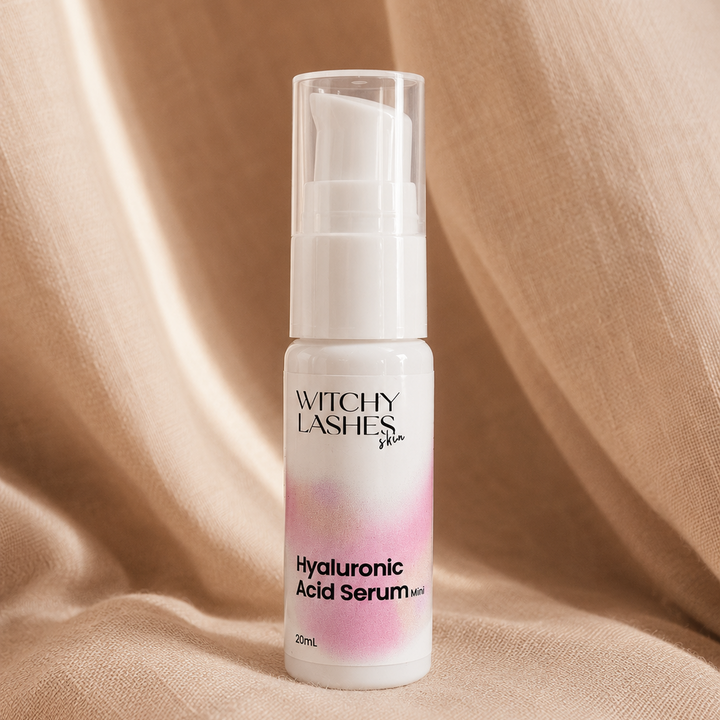


Retinol and other retinoids are commonly stopped when trying to conceive, or as soon as pregnancy is confirmed, because topical vitamin A is treated with the same caution as high-dose oral vitamin A, a known cause of birth defects. The topical evidence itself is reassuring, but the standard advice stays conservative. Always check timing with your GP or midwife. The gentlest Witchy routine for this window is the Hyaluronic Acid Serum on damp skin, sealed with a fragrance-free moisturiser.
I want to begin this article very plainly. I am not a doctor, obstetrician, midwife, maternal child health nurse, or pharmacist. I am the founder of a skincare company. Pregnancy is medical territory, and the only honest skincare answer to questions about vitamin A in pregnancy is to direct you to a clinician who knows your specific circumstances.
The rest of this article explains why the recommendation stays conservative, what the evidence actually shows, what the gap between the evidence and the recommendation is, and what the calmer alternatives are during pregnancy and breastfeeding. It is written for the woman who wants to understand the territory before she has the conversation with her clinician. It is not a substitute for that conversation.

Why the precaution exists
Vitamin A in high oral doses is a known teratogen. This is well established. There is clear evidence that excessive vitamin A intake during pregnancy, particularly in the first trimester, can cause serious birth defects.
The drug isotretinoin (Roaccutane), an oral retinoid used for severe acne, is one of the most clearly teratogenic medicines in widespread use. Australian prescribing requires explicit pregnancy prevention programmes and is absolutely contraindicated in pregnancy.
The concern about topical retinoids is an extension of this oral-dose concern, applied with appropriate caution. The reasoning: any topical product is partially absorbed through the skin. Even if the absorbed dose is much lower than an oral dose, the precautionary principle has been to avoid the entire retinoid family during pregnancy.
This precaution is built into Australian antenatal care, midwifery practice, and the consensus advice given by clinical bodies. It is reflected in the labelling of essentially every retinoid product on the market, including ours.
This is the principle. The clinical evidence is more nuanced, and we will get to it.
What the clinical evidence actually shows
Three significant studies have specifically examined the risk of topical retinoid exposure in pregnancy. The picture they produce is more reassuring than the precautionary recommendation might suggest.
A 1997 prospective cohort study in The Lancet (Shapiro et al.) followed 215 women exposed to topical tretinoin in the first trimester. The study found no statistically significant increase in major congenital malformations compared to unexposed controls [1].
A 2012 multicentre prospective study in the Journal of Clinical Pharmacology (Panchaud et al.) followed 235 women exposed to topical retinoids in pregnancy and compared them to 444 non-exposed controls. The study found no significant difference in rates of spontaneous abortion, stillbirth, gestational age at delivery, or major congenital malformations [2].
A 2025 Nordic cohort study in the British Journal of Dermatology (Refsum et al.) examined a much larger registry-based population. This is the largest cohort to date. The study found no clear increase in major congenital malformations from topical retinoid exposure [3].
The available evidence indicates topical retinoids carry low-to-no teratogenic risk in real-world use, though precautionary avoidance remains the standard recommendation given the gravity of the potential harm and the availability of alternatives.Williams et al., Birth Defects Research, 2020 [4]
The consensus across this body of research is that the clinical evidence on topical retinoids in pregnancy is reassuring. Several professional bodies have noted that women who unknowingly used topical retinoids in early pregnancy generally do not need to be told there is a meaningful added risk to their baby. But this is the important part: clinical evidence and clinical recommendation are not the same thing.
Why the recommendation remains precautionary
If the evidence is reassuring, why do clinical bodies still recommend avoiding topical retinoids in pregnancy? Several reasons.
The mechanism is real. Oral high-dose vitamin A is genuinely teratogenic. The precautionary principle treats topical exposure as a smaller version of the same concern, even when the dose is much lower.
The downside is irreversible. If a precaution turns out to have been unnecessary, the cost is small: a few months without a retinoid. If a relaxation of the precaution causes harm, the cost is serious. The asymmetry of outcomes drives the conservative recommendation.
The alternative is simple. Pregnancy lasts approximately forty weeks. Breastfeeding may last another twelve to twenty-four months. Pausing retinoid use during these windows is inconvenient but usually uncomplicated. For cosmetic skincare, the balance tips firmly toward precaution.
The evidence has limitations. The studies above, while reassuring, are not definitive. Cohort sizes are limited. Concentrations and types of retinoids vary across studies. Conservative interpretation is appropriate.
The result is a recommendation that is more conservative than the evidence alone would require. This is not unusual in medicine. It is how the precautionary principle works when the stakes are high.
The Witchy position, plainly
We do not recommend our Retinyl Renewal Oil during pregnancy or breastfeeding.
This aligns with every clinical body's position on the same question. Precaution is the right approach when the stakes are high, the alternatives are simple, and the recommendation aligns with how every doctor and midwife you will speak to is already thinking about the question.
Some brands, including some natural and botanical brands in Australia, describe retinoid products as "safe in pregnancy" or "pregnancy-friendly." We have looked at the evidence those claims rest on, and we have decided not to make them. The reassuring clinical evidence does not, in our view, support the affirmative claim that any retinoid is safe in pregnancy. It supports the claim that the actual risk is probably lower than the precautionary recommendation implies. Those are different statements.
What to use during pregnancy and breastfeeding
Pregnancy and breastfeeding do not have to be skincare-free windows. Plenty of cosmetic ingredients are well-tolerated during these periods.
The gentlest Witchy routine for this window is the Hyaluronic Acid Serum on damp skin, sealed with a fragrance-free moisturiser of your choice. Hyaluronic acid is a humectant that binds water in the upper layer of skin and has been shown to improve hydration in topical applications [5]. It has no known concerns in pregnancy.
The Witchy Hyaluronic Acid Serum is a three-ingredient formula: purified water, plant-based hyaluronic acid, and a touch of natural preservation. No active ingredients beyond hyaluronic acid. No fragrance. No essential oils. No retinoids. It is the calmest formula we make.
The Witchy Blue Tansy Calming Facial Oil contains essential oils. The general antenatal guidance is to avoid essential-oil-containing facial products during pregnancy and breastfeeding. We do not recommend the Blue Tansy oil during these windows.
For the wider routine: gentle cleansers, hyaluronic acid, simple moisturisers, mineral sunscreens (zinc oxide, titanium dioxide), and most basic skincare ingredients are well-tolerated. Avoid: retinoids of any kind, salicylic acid in high concentrations, and hydroquinone.

Hyaluronic Acid Serum
Three ingredients. No actives, no fragrance, no essential oils. Apply to damp skin, seal with a fragrance-free moisturiser of your choice. The calmest formula in the Witchy range.
See the Hyaluronic Acid SerumWhen should you stop retinol before pregnancy?
If you are planning a pregnancy and have been using a retinoid, the question of when to stop is worth raising with your GP. The standard advice is to pause topical retinoids before conception. How long before depends on which retinoid you are using and your clinician's preference. For oral retinoids like isotretinoin, the window is months. For topical retinoids including retinyl palmitate, the window is shorter, often a few weeks, but the specific advice varies between clinicians. Discuss your skincare with your GP at the same conversation you have about pregnancy planning, and follow their guidance.
What to do if you used a retinoid before knowing you were pregnant
This is one of the more common worries we hear about. The honest answer is that the clinical evidence we have cited is reassuring on this point. Women who unknowingly used topical retinoids in early pregnancy have been studied across multiple cohorts, and the studies have not found evidence of increased congenital malformations.
This does not mean you should not have the conversation with your GP. You should, both for the medical reassurance and for the documentation of your antenatal care. But it does mean this is a conversation, not a crisis. The evidence is on the side of reassurance.
The path is straightforward. Pause the retinoid as soon as you know you are pregnant. Have an early conversation with your GP, obstetrician or midwife. Move to the calmer routine for the rest of the pregnancy and breastfeeding window.
Almost every question in this article is a medical question. Please speak with a clinician about: specific advice for your pregnancy or breastfeeding situation; whether to continue any prescription medication, including retinoids, during pregnancy; skincare changes you should make during pregnancy beyond pausing retinoids; any concern about a specific skincare exposure during pregnancy; skin conditions that develop or worsen during pregnancy (including melasma and pregnancy-related rashes). The clinicians to contact: your GP, your obstetrician (if you have one), your midwife, a maternal child health nurse. The Pregnancy, Birth and Baby Helpline (1800 882 436) has a registered nurse available. Internationally: healthdirect.gov.au and RANZCOG for Australian guidance. Witchy is not on this list. Pregnancy is not our territory.

A note from Marcha
I want to write this note carefully because pregnancy is one of the places where I am most aware of my limits.
What I have come to believe, both personally and as someone who writes skincare advice for a living, is that pregnancy is exactly the moment where you should be listening to your clinician more than your skincare brand. Not because skincare brands are necessarily wrong, but because clinicians know your specific circumstances and brands cannot.
The Witchy position on retinoids in pregnancy is conservative because pregnancy is a place for conservative advice. We could write an article that emphasised the reassuring clinical evidence and reached the conclusion that topical retinyl palmitate is probably fine in pregnancy. The literature would support such an article. We have chosen not to write it, because the gap between "probably fine" and "definitely fine" is exactly the gap your clinician is trained to navigate with you, and we are not.
In the meantime, the Hyaluronic Acid Serum on damp skin, sealed with a simple fragrance-free moisturiser, is a calm, simple routine for this window. We will be here when the window has passed and the Retinyl Renewal Oil is the right product for your skin again.
Common questions
Is retinol safe during pregnancy?
Topical retinoids are not recommended during pregnancy in Australian antenatal care. The clinical evidence on topical retinoid exposure in pregnancy (Shapiro 1997, Panchaud 2012, Refsum 2025, Williams 2020) is broadly reassuring, finding no clear increase in major congenital malformations. However, the standard clinical recommendation remains to avoid retinoids during pregnancy, including topical forms. Please speak with your GP, obstetrician, or midwife about your specific circumstances.
Is retinyl palmitate safe during pregnancy?
Retinyl palmitate is the gentlest form of cosmetic vitamin A, but the precautionary recommendation against topical retinoids in pregnancy applies to retinyl palmitate as well. We do not recommend the Witchy Retinyl Renewal Oil during pregnancy or breastfeeding. Speak with your clinician for specific advice.
Can I use retinol while breastfeeding?
We do not recommend the Retinyl Renewal Oil during breastfeeding. The same precautionary reasoning that applies during pregnancy applies during breastfeeding. The Hyaluronic Acid Serum on its own, sealed with a fragrance-free moisturiser, is a calmer routine for this window.
What happens if I used retinol before I knew I was pregnant?
The clinical evidence (Shapiro 1997, Panchaud 2012, Refsum 2025) on women who unknowingly used topical retinoids in early pregnancy is broadly reassuring. The studies have not found evidence of increased congenital malformations. This is a conversation to have with your GP or obstetrician, both for the medical reassurance and for your antenatal care record. It is a conversation, not a crisis.
Can I use hyaluronic acid during pregnancy?
Hyaluronic acid is generally well-tolerated during pregnancy and breastfeeding. It is a humectant that binds water in the upper layer of skin and has been shown to improve hydration in topical applications. It has no known concerns in pregnancy. The Witchy Hyaluronic Acid Serum is a three-ingredient formula with no actives, fragrance, or essential oils, and is the calmest formula we make. Always discuss your full routine with your clinician.
Is the Witchy Blue Tansy Calming Facial Oil safe during pregnancy?
We do not recommend the Blue Tansy Calming Facial Oil during pregnancy or breastfeeding because it contains essential oils, and the general antenatal guidance is to avoid essential-oil-containing facial products during these windows. A simple, fragrance-free moisturiser of your choice is the gentler approach as the seal step.
When can I restart retinoids after pregnancy?
This depends on whether you are breastfeeding. While breastfeeding, we do not recommend restarting any retinoid. Once breastfeeding is complete, you can return to your retinoid routine, although your skin may have changed in the meantime and a gentler restart is often a good idea. Please discuss timing with your GP if you have specific questions.
The skin renewal trio
When breastfeeding is complete and you are ready to return to a retinoid routine, the three-product set brings together the Hyaluronic Acid Serum, Blue Tansy Calming Facial Oil, and Retinyl Renewal Oil in the order they are meant to be used.

Where to next
References
- Shapiro, L. et al. (1997). Safety of first trimester exposure to topical tretinoin: prospective cohort study. The Lancet, 350(9085), 1143–1144.
- Panchaud, A. et al. (2012). Pregnancy outcome following exposure to topical retinoids: a multicentre prospective study. Journal of Clinical Pharmacology, 52(12), 1844–1851.
- Refsum, I. et al. (2025). Topical retinoid use in pregnancy: a Nordic registry-based cohort study. British Journal of Dermatology.
- Williams, C. et al. (2020). Topical retinoids in pregnancy: a review of available evidence and risk communication. Birth Defects Research, 112(7), 537–546.
- Bukhari, S.N.A. et al. (2023). Hyaluronic acid, a promising skin rejuvenating biomedicine: a review of recent updates and pre-clinical and clinical investigations on cosmetic and nutricosmetic effects. International Journal of Biological Macromolecules.

