

Why Australian Summer Makes Skin So Dry (and What Actually Helps)
Australian summer creates a specific combination of stressors that depletes skin hydration faster than almost any other climate: extreme UV that degrades hyaluronic acid in skin tissue, aggressive air conditioning that drops indoor humidity well below comfortable levels, and the repeated transition between humid outdoor air and dry conditioned interiors. For women in perimenopause, whose skin is already producing less natural hyaluronic acid and has reduced barrier function, this seasonal pressure arrives on a lower baseline. A humectant applied on damp skin after every wash, sealed with a moisturiser, is the single most effective routine adjustment for summer skin dryness in Australia.
Most Australians expect summer to mean oily, sweaty skin. The reality for many women in their forties and beyond is the opposite: summer is the season their skin feels driest, most reactive, and most difficult to manage.
This is not a paradox. It is the predictable result of specific Australian summer conditions acting on skin that has less internal hydration capacity than it used to. Understanding the mechanism makes the fix obvious.
Why Australian summer is harder on skin than it looks
UV intensity
Australia has some of the highest UV levels in the world. The UV Index regularly reaches 11 or above (Extreme) during summer months in most capital cities, and can exceed 14 in northern Australia. This matters for skin hydration because UV radiation directly degrades hyaluronic acid in the dermis. [2] The molecule responsible for holding water in skin tissue is broken down faster than it can be replenished under sustained high-UV exposure. SPF is not just a sun protection measure in Australia: it is a hydration preservation measure. Skin that is consistently sun-exposed without protection dries from the inside out at an accelerated rate.
The indoor humidity problem
The overlooked factor in summer skin dryness is air conditioning. Most Australian offices, homes, shopping centres, and cars run air conditioning from October through March. Air conditioning removes moisture from the air to cool it. Indoor humidity in air-conditioned spaces typically sits between 30% and 50%, and can fall lower in heavily conditioned environments. The skin is constantly trying to equilibrate with the surrounding air: in low-humidity conditions, it loses water to the air faster than in humid conditions.
The result is that many Australians spend eight or more hours per day in air-conditioned environments during summer, with their skin losing water to the dry indoor air even as the outdoor temperature climbs. This is a larger driver of summer skin dryness than the heat itself.
The transition effect
Moving repeatedly between humid outdoor air (which in coastal cities like Sydney and Brisbane can reach 70 to 90% humidity in summer) and air-conditioned interiors (30 to 50% humidity) forces the skin to repeatedly adjust. Each transition is a micro-stress on the barrier. Over the course of a workday, a person might make this transition four to six times. The cumulative effect on barrier function is significant, particularly for skin that is already less resilient from hormonal changes or consistent under-hydration.
City by city: where Australian summer hits hardest on skin
Brisbane and South East Queensland
High outdoor humidity (often 70%+) but severe air conditioning indoors. The humidity swing between outside and inside is among the largest of any Australian city. Skin often feels fine outdoors and parched indoors. The transition stress is the dominant issue here.
Sydney
Moderate to high coastal humidity outdoors, aggressive air conditioning in offices and on public transport. UV is consistently extreme from November through February. A reliable SPF routine and a morning humectant step are the two highest-impact changes.
Melbourne
Lower baseline humidity than the northern coastal cities, with the added challenge of extreme temperature variability (40°C one day, 22°C the next). Skin routines need to be stable enough to handle both conditions without switching products constantly.
Perth and Adelaide
Low outdoor humidity in summer, high UV, and strong inland winds that mechanically stress the barrier. Some of the highest TEWL conditions in the country. A serum on damp skin is not optional here: it is the minimum.
Why perimenopause makes this worse
For women in perimenopause, Australian summer arrives on a skin that is already working from a lower baseline. Declining oestrogen reduces the skin's own production of hyaluronic acid, which means there is less internal water-holding capacity before the external summer pressure begins. [2] Barrier function is also reduced, meaning the skin is less able to resist the drying effect of UV, low humidity, and environmental stress.
The practical outcome: a summer that felt manageable at thirty-five may feel genuinely difficult at forty-five, not because the summer got worse, but because the skin's resilience to it has changed. The routine that was fine in September may need adjustment by December.
Oestrogen deficiency accelerates the degradation of hyaluronic acid in the dermis and reduces the skin's capacity to retain moisture, compounding the external moisture loss associated with UV exposure and low-humidity environments.Lephart & Naftolin (2022) [2]
The summer two-step: what to adjust and when
The Australian summer routine adjustment is less about adding products and more about precision in the two steps that matter most: humectant timing and SPF.
Step one: humectant on damp skin, every wash
This is the highest-return single change for summer skin dryness. After every face wash (morning and evening), apply a Hyaluronic Acid Serum while skin is still visibly damp. The humectant draws and retains the surface water before it can evaporate. In a low-humidity air-conditioned environment, this step makes a measurable difference in how skin feels through the day. [1]
Timing is everything: damp skin, within 30 seconds of rinsing. Applying the serum to dry skin in a dry air-conditioned environment can work against you, drawing water from the deeper skin layers toward the surface where it then evaporates.
Step two: SPF as the non-negotiable seal
In Australian summer, SPF 50+ is the morning seal. It sits over the moisturiser and provides the occlusive barrier against both UV-driven HA degradation and environmental drying. If your current SPF formula feels drying, a mineral SPF (zinc oxide based) is generally better tolerated on sensitive or perimenopausal skin than chemical-filter formulas.

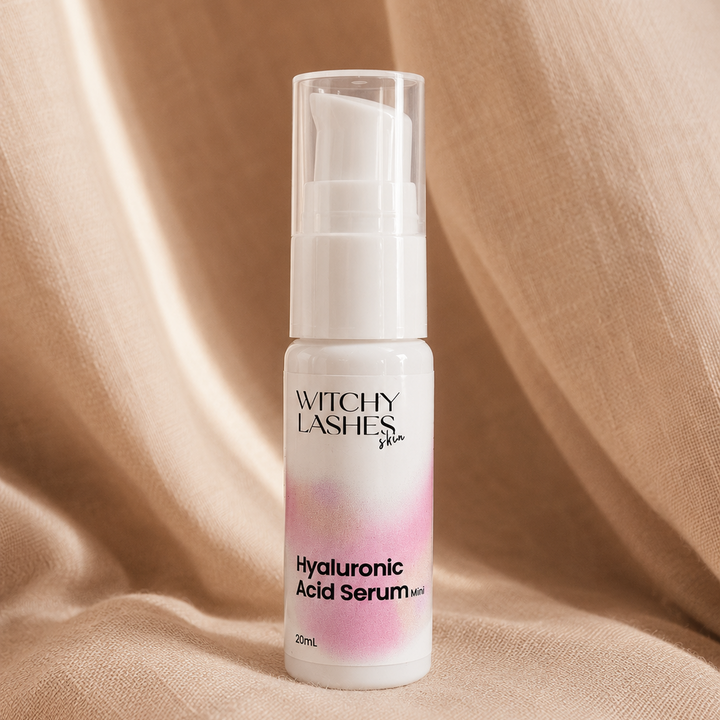
Witchy Lashes Hyaluronic Acid Serum
Lightweight, three-weight hyaluronic acid serum for the damp-skin step. Sits under SPF 50+ without pilling. No fragrance, no alcohol. The one routine change that addresses both air-conditioned indoor dryness and UV-driven moisture loss.
See the Hyaluronic Acid SerumThe compounding effect: when changing skin meets Australian summer
The challenge that many women notice in their forties is that the two pressures arrive together: perimenopause-related skin changes and the Australian summer compound each other in a way that feels sudden. Skin that held up well through previous summers starts to struggle. The explanation is straightforward: the skin's reserves were sufficient before the hormonal shift, and now the external pressure of summer exceeds what the skin can manage internally.
The response is not a more complex routine. It is a more precise routine: humectant on damp skin every wash, SPF every morning, and in the evening, after the serum step, a few drops of Blue Tansy Calming Facial Oil pressed over the moisturiser as the overnight seal. The oil provides the occlusive layer that is absent at night (no SPF), allowing the skin to recover moisture through the hours when it is not being exposed to further UV or air conditioning.
"The summer routine is simpler than most people expect. The precision is the whole thing."
Skin dryness that does not respond to a consistent gentle routine, or that is accompanied by redness, bumps, itching, or flaking that spreads, warrants a GP or dermatologist appointment. Australian summer also brings increased risk of UV-related skin changes: any new or changing mole, spot, or lesion should be assessed by a GP or dermatologist promptly. For perimenopause questions beyond skin, the Australian Menopause Society's find-a-doctor tool is at menopause.org.au. Jean Hailes for Women's Health at jeanhailes.org.au is a further Australian resource.

Sydney summers are their own thing. Humid outside, cold air conditioning inside, and skin caught in the middle of that back-and-forth all day. I used to think summer skin was an oil problem. It turned out it was a hydration problem hiding under the sweat.
The Renewal Ritual is what I use year round, but summer is when I notice the difference most. Serum on damp skin the moment I step out of the shower, before the air conditioning has a chance to pull everything tight. It takes thirty seconds, and it changes how my skin feels for the rest of the day.
Marcha, founder of Witchy Lashes
Common questions
Why does my skin feel dry in summer when it's so humid outside?
Because most of your time is spent indoors, not outdoors. Air conditioning dramatically reduces indoor humidity, often to 30 to 50%, well below the outdoor humidity in coastal Australian cities in summer. The skin responds to the environment it is actually in, and for most working Australians that is an air-conditioned interior for the majority of the day. The outdoor humidity is largely irrelevant to your skin's hydration if you are inside most of the time. The transition between environments adds its own stress. The effective fix targets what happens indoors, not what happens outside.
Should I change my moisturiser in summer?
Not necessarily. The adjustment that matters most is not the moisturiser weight but the addition of a humectant step on damp skin before the moisturiser. A lighter moisturiser in summer makes sense if your current one feels heavy or congesting in the heat, but switching to a lighter formula without adding the humectant step often makes dryness worse, not better. If you do switch to a lighter moisturiser, compensate by being more precise about the serum-on-damp-skin step.
Does swimming in the ocean or pool affect skin hydration?
Both can. Salt water has an osmotic effect that draws water from the skin. Chlorinated pool water disrupts the skin's microbiome and can compromise barrier function with frequent exposure. The fix after swimming is the same as after a face wash: rinse with fresh water, then apply a hyaluronic acid serum while skin is still damp, then seal with a moisturiser. Do not let the skin air-dry after a swim before applying anything, especially in direct sun. The evaporation rate in Australian summer sun is fast enough to leave the skin significantly depleted within minutes.
Is a facial mist useful for skin dryness in air conditioning?
A facial mist provides temporary relief but can worsen dryness if used without sealing. Plain water misted onto the face will evaporate and take some of the skin's existing moisture with it in a low-humidity environment. A mist that contains a humectant (hyaluronic acid or glycerin) is more useful, and sealing with a moisturiser or light facial oil immediately after misting is what preserves the benefit. Used correctly, a humectant mist midday in an air-conditioned office can be a practical refresh. Used without sealing, it is counterproductive.
Does drinking more water help with summer skin dryness?
Staying well hydrated matters for overall health, but the evidence for drinking water improving skin surface hydration in already-hydrated people is limited. The skin's surface hydration is more directly influenced by what you apply to it than by systemic water intake (as long as you are not significantly dehydrated). If you are genuinely dehydrated systemically, hydration will improve many things including skin. But for someone who drinks adequate water, adding more is unlikely to resolve surface skin dryness the way a topical humectant routine will.
When should I start my summer skin routine?
Before you notice the dryness, not after. The UV Index in Australia starts reaching Extreme levels in October in most cities. Starting the humectant-on-damp-skin step and consistent SPF 50+ in September or early October means the skin enters the peak summer months with a well-maintained baseline, rather than trying to recover from two months of cumulative dehydration by December. If your skin is already feeling the effects of summer, the same routine applies: it will take one to two weeks of consistency to stabilise.
The Renewal Ritual
Hyaluronic Acid Serum on damp skin after every wash. Blue Tansy Calming Facial Oil to seal overnight. The routine built for Australian conditions on skin that has less internal hydration capacity than it used to.

Related reading
References
- Bukhari, S. N. A., Roswandi, N. L., Waqas, M., Habib, H., Hussain, F., Khan, S., Sohail, M., Ramli, N. A., Thu, H. E., & Hussain, Z. (2018). Hyaluronic acid, a promising skin rejuvenating biomedicine: A review of recent updates and pre-clinical and clinical investigations on cosmetic and nutricosmetic effects. International Journal of Biological Macromolecules, 120(B), 1682–1695.
- Lephart, E. D., & Naftolin, F. (2022). Menopause and the skin: old favorites and new innovations in cosmeceuticals for estrogen-deficient skin. Dermatology and Therapy, 11(1), 53–69.

