

Calming Skincare in Australia: A Gentle, Honest Routine for Skin That Feels Reactive
Calming skincare is not really about one magic product or one special ingredient. It is a style of routine for skin that feels reactive, sensitive, hot, tight, stressed or easily upset. It is not a treatment for a medical condition like rosacea, eczema or perioral dermatitis. Those deserve a GP or dermatologist. If your skin has visible bumps, persistent redness, a rash that is spreading, or burning that does not settle, please see a doctor before adding products.
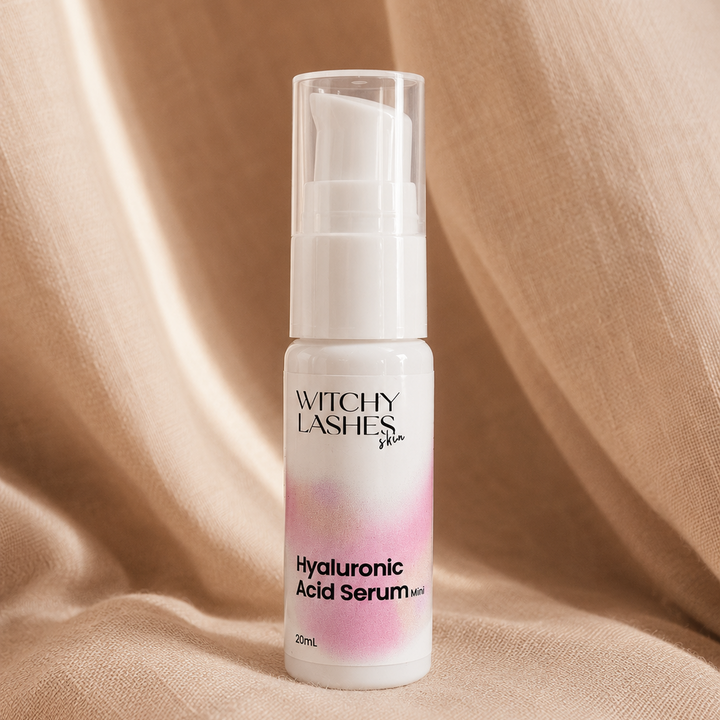
For skin that simply feels reactive, the answer is usually less, not more. A gentle cleanser. A humectant on damp skin, like hyaluronic acid, to bring water in. A calming facial oil over the top to slow water from leaving. Sunscreen in the morning. The Witchy two-product approach is a hyaluronic acid serum first, then a botanical facial oil over the top. Water in, water held. Built for skin that has become reactive in perimenopause, after over-exfoliation, after a long Australian summer, or simply because your skin is changing.
How to tell what your skin is actually telling you
We do not always describe reactive skin in the same words as a dermatologist would. A dermatologist might say "facial erythema" or "inflammatory response". You might say "my face looks angry", or "everything stings now", or "I look tired and red". Often, those are the same observations in different language.
The starting point is to notice what your skin is doing, in your own words, before you start adding or removing products.
Some of the most common things women describe when their skin feels reactive:
- Burning or tingling when you apply almost anything.
- Tightness that does not settle, even after moisturiser.
- Redness in the cheeks, around the nose, or across the forehead.
- Visible little fine lines that look sharper than usual.
- Skin that looks shiny and feels dry at the same time.
- Patches that flake when you smile, talk, or touch your face.
- A general feeling that your face looks tired or hot, even when you feel fine.
Most of these are routine-and-environment patterns, not medical conditions. A few of them might be. We will come back to that.
The eight things that most commonly make skin feel reactive
There is usually not one dramatic reason. More often it is one or two of these, quietly stacked.
1. The weather and the air. Australian summer is one of the harder climates for skin. Strong UV, hot outdoor air, low-humidity air-conditioning indoors, salt water, pool chlorine. Skin holds water comfortably at around fifty to sixty per cent relative humidity. Most air-conditioned rooms run at twenty-five to forty per cent. Eight hours in that environment is, in skin terms, eight hours in a desert.
2. Over-actives. Acids, retinols, vitamin C, scrubs and exfoliating tools, used too often or stacked together, can leave your skin's surface raw and reactive. This is one of the most common quiet causes of suddenly-sensitive skin. If this sounds familiar, the first step is a simple humectant: Hyaluronic Acid Serum on damp skin gives your barrier water to work with while you pull back.
3. A new product, not always a new active. Sometimes the trigger is a fragrance, an essential oil, a preservative, or an ingredient that interacts poorly with something else you are using. The skin may react days after the product was introduced.
4. Perimenopause. Oestrogen supports skin's oil production, water-holding capacity and resilience. As oestrogen shifts in your late thirties, forties or fifties, skin that was robust for years can suddenly feel thinner and more reactive. Many women describe this as their skin "just changing on me".
5. Postpartum and breastfeeding. Hormones drop sharply after giving birth. Skin that was glowing during pregnancy can feel completely different a few months later.
6. Stress, sleep and burnout. Cortisol, sleep debt and chronic stress affect immune function and skin barrier function. Many women notice their skin looks "angry" before they consciously realise how stressed they are.
7. After a facial, peel, microneedling or laser. Your skin is in genuine recovery for days or weeks after a procedure. The right products in that window matter more than usual.
8. A medical condition. Rosacea, eczema, perioral dermatitis, contact dermatitis and other conditions can cause reactivity. These are diagnosed by a GP or dermatologist, not by guessing.
If you can name which one or two of these are probably yours, the right next step usually becomes much clearer.
The calm-feeling routine
The principle is straightforward. Reactive-feeling skin often asks for less, not more. The job of a good calming routine is to give your skin water, slow that water from leaving, and stop irritating it with anything else.
Step one: a gentle cleanser. Cream-based, lotion-based, or oil-based, depending on what feels right. Skip foaming cleansers for a few weeks if your skin is actively reactive. Use cool to lukewarm water, not hot.
Step two: a humectant on damp skin. Within sixty seconds of rinsing, press in a few drops of Hyaluronic Acid Serum onto skin that is still slightly damp. This is the water-in step. Hyaluronic acid is a humectant that can hold up to a thousand times its weight in water and has been shown to improve skin hydration in topical applications (Bukhari et al., 2023). The Witchy serum is a three-ingredient formula: purified water, plant-based hyaluronic acid, and a touch of natural preservation. No fragrance, no essential oils, no fillers.
Step three: a seal. Wait about thirty seconds, then press in three to four drops of Blue Tansy Calming Facial Oil over the top. The oil slows transepidermal water loss. Blue tansy is a botanical oil rich in chamazulene, a compound with documented anti-inflammatory properties in laboratory and in-vitro studies (Slon et al., 2024).
Step four: sunscreen, in the morning only.
That is the routine in its simplest form. Morning and evening. You can use this routine on its own, or alongside your existing skincare with the actives temporarily paused while your skin settles.
Research on occlusive formulations has shown that adding a seal over a hydration step can reduce transepidermal water loss by between thirty and eighty per cent, depending on formulation.Moisturiser formulation review, PMC9315586
Why the two products were designed to work together
Hyaluronic acid is a humectant. It draws water into the upper layer of the skin. It works best when there is something over the top to slow that water from leaving again. Without a seal, in dry Australian air, a humectant can sometimes pull water from deeper layers of skin to the surface, where it evaporates and leaves you feeling tighter than before.
A facial oil acts as an occlusive step. It forms a fine layer over the skin and slows that water loss. Without a humectant underneath, an oil traps very little, because there was not much water in the upper layer to begin with.
The two need each other. The Witchy hyaluronic acid serum was deliberately formulated as a three-ingredient water-based serum, with no actives that could interfere with the calming botanicals in the facial oil. The oil was formulated to be calm enough to apply over a serum, light enough to layer under sunscreen, and to feel like the right closing step rather than a heavy occlusive. They were made to sit together. That is not just marketing language. It is the formulation logic.

Blue Tansy Calming Facial Oil
Rich in chamazulene, the compound with documented anti-inflammatory effects in laboratory studies. Designed to sit over the hyaluronic acid serum as a gentle evening seal.
Read the formulaWhen this might be something else
A calming routine is helpful for skin that feels reactive. It is not a treatment for a medical condition.
If any of the following are true, please see a GP or dermatologist before changing your skincare:
- You have small raised bumps, not just dry-feeling skin.
- There is persistent redness that does not settle within a few weeks of a gentler routine.
- Your skin is burning, stinging, peeling, weeping, or cracking.
- The redness is concentrated around the mouth or nose with a clear strip of healthy skin at the lip edge (this can be perioral dermatitis).
- The redness comes with visible blood vessels, flushing, or eye irritation (these can be signs of rosacea).
- You have patches that itch and worsen, especially in folds of skin (this can be eczema).
- You recently used a steroid cream, even briefly.
- The reaction started suddenly after a specific product, food, medication, or environmental change.
healthdirect.gov.au has plain-English guides on rosacea, eczema, perioral dermatitis and contact dermatitis, plus a registered nurse you can call any time of day. The Australasian College of Dermatologists A to Z of Skin is the AU specialist resource for condition-specific information. A calming routine is not a substitute for a proper diagnosis.
What we do not recommend
During pregnancy and breastfeeding. The Blue Tansy Calming Facial Oil contains essential oils, and we do not recommend it during pregnancy or breastfeeding. The hyaluronic acid serum is a three-ingredient formula with no essential oils, and is the calmer starting point during this window. Please speak with your GP, obstetrician, midwife or maternal child-health nurse if you have specific questions.
During active cancer treatment. If you are in chemotherapy, radiation or immunotherapy, please speak with your treating clinician before using essential-oil-containing skincare. The hyaluronic acid serum, with no essential oils, is often a gentler option, but please ask your team first.
If you have a known ragweed, chamomile or feverfew allergy. Blue tansy is in the same plant family (Asteraceae). Patch test on the inner forearm for forty-eight hours before applying to your face.
If your skin is in active eczema or perioral dermatitis flare. A heavier oil can sometimes make these conditions worse. The hyaluronic acid serum on its own, sealed with a fragrance-free moisturiser of your choice, is the more cautious starting point until your skin has settled and your GP is comfortable with you reintroducing other products.
Where to next in this topic
Reading by intent:
- If your skin became reactive after using too many active ingredients, read our piece on over-exfoliated skin and the gentle reset.
- If your skin feels reactive after a long Australian summer day, read our piece on calming the look of redness after wind, sun and chlorine.
- If your skin recently started feeling sensitive when it never used to be, read our piece on how to calm skin that suddenly feels sensitive.
- If your skin reacts when you are stressed or sleep-deprived, read our piece on stress, burnout and the way your skin looks back at you.
- If your skin became reactive in your forties, read our piece on perimenopause and reactive skin.
- If you have just had a facial, peel or laser treatment, read our piece on calming aftercare your therapist will approve of.
- If you would like to read more about why a hyaluronic acid serum and a facial oil work better together than alone, read our piece on the two-product routine, explained.
- If you would like to read about Blue Tansy as an ingredient, read our piece on Blue Tansy for skin, what it is, what chamazulene does, and who should not use it.
- If your skin feels like it might be in rosacea territory, read our piece on skincare for skin that feels like rosacea (and when to see a GP), and please book in with your doctor.
- If you live with eczema-prone skin, read our piece on a calmer everyday routine for eczema-prone-feeling skin.

When I started making my own skincare, I was not making it for everyone. I was making it for the kind of skin I had begun to live in. Skin that was changing. Skin that had stopped responding to the same routines I had used for fifteen years. Skin that flushed in the heat, tightened in the air-con, and looked tired even when I was not.
The most common message I have read across seven years of Witchy customers is some version of this: I never had sensitive skin in my life and now everything I put on my face seems to upset it.
The routine I have landed on is the simplest one I have used. Water on damp skin. A botanical oil over the top. Sun protection. Pause the actives. Cleanser as gentle as you can manage. Sleep, water, sunlight when you can. A GP appointment when something does not settle. That is genuinely the whole approach. The Renewal Ritual brings both steps together in one pairing.
Marcha, founder of Witchy Lashes Skin
Common questions
What is "calming skincare"?
Calming skincare is a style of routine designed for skin that feels reactive, sensitive, hot, tight, stressed or angry. It usually means using fewer products, focusing on hydration and gentle ingredients, and avoiding active ingredients (acids, retinols, strong vitamin C) until the skin settles. It is not a treatment for medical conditions like rosacea or eczema. Those need a GP.
How do I know if my skin is sensitive or sensitised?
Sensitive skin is a long-term pattern, often genetic, where your skin tends to react to many things across your life. Sensitised skin is a more recent change, often caused by something specific like over-exfoliation, a new product, stress, climate change, hormones, or a recent procedure. Sensitised skin can usually be calmed with a simpler routine. Sensitive skin needs ongoing gentle care. A few weeks on a pared-back routine usually shows you which is yours.
Can hyaluronic acid help reactive skin?
Yes, in most cases. Hyaluronic acid is a humectant that has been shown to bind water in the upper layer of the skin and improve hydration in topical applications. It is well tolerated by almost all skin types. It works best applied to slightly damp skin and sealed with something over the top, like a facial oil or simple cream, so the water stays where you put it.
Is Blue Tansy safe for sensitive skin?
Blue tansy is widely used in calming-feeling skincare and is generally well tolerated, but it does contain essential oils. If you are pregnant, breastfeeding, in active cancer treatment, or have a known ragweed, chamomile or feverfew allergy, we do not recommend it. If your skin is in active eczema or perioral dermatitis flare, hold the oil and use just the hyaluronic acid serum until your skin has settled and your GP is comfortable. For most other reactive skin, patch test on the inner forearm for two nights, then start with two to three drops on damp skin sealed under a humectant.
How long does it take to calm reactive skin?
Most routine-related reactivity settles within two to four weeks of a simpler, gentler routine. If your skin has not noticeably calmed in four weeks, look at your cleanser, your environment, and whether there might be an underlying condition that needs a GP visit.
Can I keep using retinol or vitamin C while using a calming routine?
For genuinely reactive skin, the simplest path is to pause active ingredients for a few weeks while your skin settles. Once it is calm again, you can reintroduce one active at a time, starting with the gentlest, on every second or third evening. If your skin reacts again, that active or that frequency is probably not right for you yet.
When should I see a GP instead of trying skincare?
Any time you have bumps, persistent redness, a spreading rash, burning, weeping, cracking, or anything that has been worsening for more than two or three weeks despite a gentler routine. Also any time you suspect an allergic reaction to a specific ingredient. A GP appointment usually saves months of frustration when something is more than a routine question.
The Renewal Ritual
Hyaluronic Acid Serum on damp skin. Blue Tansy Calming Facial Oil to seal. The complete calming routine in one pairing.


Related reading
References
- Bukhari, S. N. A., et al. (2023). Hyaluronic acid, a promising skin rejuvenating biomedicine: A review of recent updates and pre-clinical and clinical investigations on cosmetic and nutricosmetic effects. International Journal of Biological Macromolecules.
- Slon, K., Szumny, A., Nawrot-Hadzik, I., & Hadzik, J. (2024). Azulene and its derivatives as potential compounds in the therapy of dermatological and anticancer diseases. Molecules, 29(9), 2028. PMID: 38731510.

