

Flaky Skin Around the Mouth and Nose: Causes, Checks, and What Helps
Flaking around the mouth and nose is most often barrier dehydration: the skin in those areas is thinner, more mobile, and more exposed to habitual lip-licking, nose-blowing, and facial expressions that repeatedly stress the barrier. The fix for dehydration-based flaking is a humectant applied to damp skin, followed by a gentle seal. However, flaking accompanied by small bumps, persistent redness, or a pattern that spreads beyond the nasolabial fold warrants a GP visit, as it may indicate perioral dermatitis or another condition that needs a different approach.
Flaky skin around the mouth and nose is one of those skin complaints that feels minor but is genuinely difficult to manage with makeup. Foundation catches on dry patches and makes them more visible, not less. Concealer does the same. The flakes return within hours.
Before reaching for a heavier moisturiser or an exfoliant (both common instincts that often make things worse), it is worth understanding what is actually causing the flaking. The answer changes what helps.
Check this first: is it dehydration or something else?
The most important distinction to make before trying any new product is whether the flaking is dry and dehydrated skin, which responds well to a consistent hydration routine, or whether it is a skin condition that needs medical attention.
If your flaking is accompanied by any of the following, book a GP or dermatologist appointment rather than adjusting your skincare: small bumps or pustules around the mouth or nose (with or without redness), a rash that seems to worsen with moisturiser, flaking that spreads beyond the nasolabial fold toward the chin or cheeks, or any skin change that appeared suddenly and does not improve within two weeks of gentle care. These patterns can indicate perioral dermatitis, seborrhoeic dermatitis, or rosacea, each of which needs a different treatment approach.
If your flaking is dry and peeling without bumps, redness beyond mild dryness, or spreading patterns, dehydration and barrier disruption are the most likely causes and a gentle hydration routine is the right starting point.
Why flaking concentrates around the mouth and nose
The skin around the mouth and nose has some specific characteristics that make it more prone to dryness and flaking than other facial areas:
The skin is thinner here
The stratum corneum (outer skin layer) is thinner around the mouth and nasolabial fold. Thinner outer layers have less capacity to hold moisture and less structural resilience against the repeated micro-movement from talking, eating, and facial expressions. The skin flexes hundreds of times a day in this region, which stresses the barrier more than comparable areas on the cheeks or forehead.
Habitual moisture sources that actually dry
Lip-licking is one of the most common causes of perioral dryness and flaking that people do not connect to their skincare. Saliva contains digestive enzymes that break down the skin barrier. The temporary moisture from licking is followed by faster evaporation, leaving the area drier than before. Frequent nose-blowing, particularly with tissues, has a similar mechanical effect, repeatedly stripping the thin skin just below the nostrils.
Sunscreen and makeup over dry skin
Many high-SPF sunscreens, particularly chemical-filter formulas, use ingredients that can be drying to barrier-compromised skin. Applied over already-depleted skin without a humectant base, they sit in the dry surface cells and make flaking more visible. The nasolabial fold, where product pools, is often where this effect is most pronounced.
Hormonal shifts from perimenopause
Declining oestrogen reduces both natural hyaluronic acid production and barrier lipid production across the whole face, but the areas with thinner skin, including around the mouth and nose, show the effect earlier and more visibly. [2] Women who have never had dry skin in this area before sometimes notice it starting in the early to mid forties, alongside other perimenopause-related skin changes.
What makes flaking worse (common mistakes)
Exfoliating a disrupted barrier
The instinct when seeing flakes is often to remove them with an exfoliant. This is usually the wrong move for barrier-disrupted skin. If the underlying issue is dehydration, exfoliating removes the surface cells that are still providing some barrier protection, while doing nothing to address the water deficit underneath. The flakes return faster, and the skin becomes more reactive. Gentle is correct. Exfoliation, if used at all, should wait until the barrier has stabilised.
Applying a rich moisturiser without a humectant underneath
A thick moisturiser applied to dry, depleted skin around the mouth seals in whatever hydration is there, which may not be enough. It can also feel heavy or pill under makeup in the nasolabial fold. The more effective approach is a humectant on damp skin first, then a lighter moisturiser over the top to seal. This sequence puts water into the skin rather than just sealing a deficit.
Skipping this area when applying serum
Many people apply serum to their cheeks, forehead, and chin but avoid the close-to-lip and nose areas from habit. This leaves the areas that most need humectant support without it. A Hyaluronic Acid Serum applied to damp skin should cover the nasolabial fold and the skin just below the nose, not just the main planes of the face.
Hyaluronic acid applied topically to the nasolabial fold region demonstrated measurable improvements in skin hydration and a reduction in surface dryness in study participants over a 12-week period, with effects most pronounced in participants aged 45 and over.Bukhari et al. (2018) [1]
The routine that addresses dehydration-based flaking
For flaking that is dry and peeling without accompanying bumps or spreading redness, the following sequence addresses the root cause:
- Cleanse gently. A non-foaming or low-foam cleanser that does not leave skin feeling tight. Rinse with lukewarm water.
- Apply hyaluronic acid serum immediately to damp skin. Include the nasolabial fold, the area above the lip line, and the skin below the nostrils. Press in gently rather than rubbing.
- Wait 60 seconds, then apply a lighter moisturiser over the top. This seals the hydration in without adding heavy texture that pools in folds.
- Morning only: apply SPF over the moisturiser. If your current SPF formula is drying, consider a mineral SPF, which tends to be better tolerated on barrier-sensitive skin.
Evening: after cleansing and the serum step, a few drops of Blue Tansy Calming Facial Oil pressed over the moisturiser provides an occlusive seal that supports overnight barrier recovery. Blue tansy oil has calming properties that are particularly useful around the mouth area, where skin tends to be reactive from daily movement and environmental exposure.

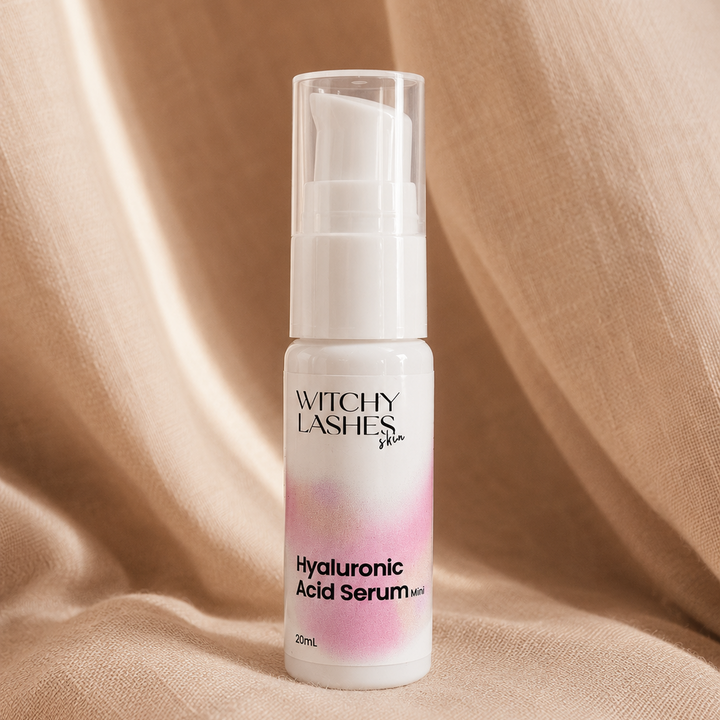
Witchy Lashes Hyaluronic Acid Serum
Three molecular weights of hyaluronic acid for application to damp skin. Lightweight enough to sit under SPF and makeup without pilling in the nasolabial fold. No fragrance, no alcohol.
See the Hyaluronic Acid SerumA note on perioral dermatitis
Perioral dermatitis is a skin condition that presents as small bumps, sometimes pustule-like, around the mouth, often with redness and occasional mild flaking. It is more common in women than men and frequently appears or worsens in the thirties to fifties. It is sometimes mistaken for acne, rosacea, or eczema.
The important distinction: perioral dermatitis typically does not improve with heavier moisturisers and can worsen with certain skincare ingredients, particularly fluorinated corticosteroids (sometimes present in prescription creams used for other conditions) and heavy, occlusive products. Applying a rich moisturiser or facial oil to perioral dermatitis may make it worse, not better.
If you are unsure whether what you have is dehydration-based flaking or perioral dermatitis, the safest approach is a GP appointment first. A correct diagnosis changes the management completely. This article is specifically about dry, flaking skin without bumps. If you have bumps in this area, please see a doctor before changing your routine.
See your GP or a dermatologist if: flaking is accompanied by small bumps or pustules around the mouth or nose; the affected area is red, spreading, or worsening with moisturisers; flaking is accompanied by itching or burning; or the skin has not improved with two weeks of a consistent gentle routine. Perioral dermatitis, seborrhoeic dermatitis, and rosacea all need medical assessment and cannot be managed with skincare alone. If you are in perimenopause and experiencing skin changes alongside other symptoms, the Australian Menopause Society's find-a-doctor tool is at menopause.org.au.

The nasolabial fold is where I notice dehydration in my own skin first. It is where foundation catches, where flaking shows, and where the first signs of a disrupted barrier appear for me. The temptation is always to put a heavier cream there. What actually works is the serum step first, specifically in that area, on damp skin, before anything else goes on.
The Renewal Ritual, the serum and the Blue Tansy oil, is what I use morning and evening in that region. It is the only thing that keeps the fold comfortable through an Australian summer.
Marcha, founder of Witchy Lashes
Common questions
Is flaky skin around the mouth always a sign of dehydration?
No. Flaking in that area can indicate dehydration and barrier disruption, but it can also indicate perioral dermatitis, seborrhoeic dermatitis, contact dermatitis (a reaction to a product or food), or rosacea. The key differentiator is the presence of bumps, spreading redness, or a pattern that does not respond to a gentle hydration routine. Dry flaking without bumps and without spreading is more likely to be dehydration. Flaking with any of those accompanying signs warrants a GP visit before adjusting skincare.
Can toothpaste cause flaky skin around the mouth?
Yes. Sodium lauryl sulphate (SLS), a foaming agent in many toothpastes, is a known irritant for the skin around the mouth and is associated with perioral dermatitis in some people. Fluoride in toothpaste can also cause a reaction in sensitive individuals. If flaking around the mouth appeared or worsened at the same time as a toothpaste change, or if it is concentrated directly at the lip margin, toothpaste contact is worth investigating. SLS-free toothpastes are widely available in Australian pharmacies.
Why does my skin flake more around the nose in winter?
Two factors combine in winter: lower outdoor humidity, which increases transepidermal water loss, and indoor heating, which further dries the air. The skin below the nostrils is also mechanically stressed by nose-blowing more frequently during winter illnesses. The combination of environmental drying, mechanical disruption, and the thin skin in that area makes winter nose-area flaking common. A consistent humectant routine and a non-irritating barrier cream just below the nostrils (at night) usually resolves it within a week or two.
Should I exfoliate the flaky skin around my mouth?
Usually no, at least not initially. Exfoliating compromised skin removes the surface cells that are providing some barrier protection, without addressing the hydration deficit underneath. The flakes typically return faster and the skin becomes more reactive. The better approach is to hydrate first (serum on damp skin, then seal) and let the skin stabilise over one to two weeks. Once the barrier is more intact, very gentle, occasional exfoliation (a mild lactic acid once a week, for example) can help surface renewal without disrupting recovery.
Can foundation cause flaking around the mouth and nose?
Foundation does not usually cause flaking, but it can make existing flaking significantly more visible by catching on dry patches and lifting them. If foundation is highlighting flaking in this area, the solution is in the skincare preparation, not the foundation formula. A hydrated, humectant-primed base allows foundation to sit more smoothly. Some foundation formulas with high alcohol or mattifying ingredients can worsen dryness on a compromised barrier. A thin, hydrating primer or just a well-applied serum-and-moisturiser base is usually more effective than switching foundations.
Is flaky skin around the mouth related to perimenopause?
It can be. Declining oestrogen reduces natural hyaluronic acid production, barrier lipid production, and skin surface hydration across the face. The areas with thinner skin, including around the mouth and the nasolabial fold, show these effects earlier and more noticeably than the cheeks or forehead. Women who have never experienced dryness in that area before sometimes notice it appearing in their early to mid forties. If this is new for you and appears alongside other changes (sleep, cycles, mood, joint discomfort), speaking with your GP about the broader picture of perimenopause is worthwhile.
The Renewal Ritual
Hyaluronic Acid Serum on damp skin for the nasolabial fold and the areas around the mouth. Blue Tansy Calming Facial Oil to seal and support barrier recovery overnight.
Related reading
References
- Bukhari, S. N. A., Roswandi, N. L., Waqas, M., Habib, H., Hussain, F., Khan, S., Sohail, M., Ramli, N. A., Thu, H. E., & Hussain, Z. (2018). Hyaluronic acid, a promising skin rejuvenating biomedicine: A review of recent updates and pre-clinical and clinical investigations on cosmetic and nutricosmetic effects. International Journal of Biological Macromolecules, 120(B), 1682–1695.
- Lephart, E. D., & Naftolin, F. (2022). Menopause and the skin: old favorites and new innovations in cosmeceuticals for estrogen-deficient skin. Dermatology and Therapy, 11(1), 53–69.

