

Reviewed by Caryna, Witchy Lashes Skin's cosmetic chemist, who has spent nearly two decades formulating with natural and botanical ingredients. Written by Marcha, founder of Witchy Lashes Skin.
If you have started noticing that your skin feels different and you cannot quite put your finger on why, you are probably not imagining it. Perimenopause is a real, well-documented biological transition, and your skin is one of its more sensitive registers.
This guide walks through what is actually changing, why your old routine may have stopped working, and what actually helps, from the hydration and barrier questions through to the specific products and routine that make up a simple, sustainable perimenopause skincare approach. It focuses on cosmetic skincare, the things you can change in your bathroom cabinet. Menopausal hormone therapy and other medical treatments are a separate, GP-led conversation, and we point to where to have that conversation later in this guide.
What happens to your skin in perimenopause?
Perimenopause is the years of hormonal transition before menopause. Menopause itself is defined as twelve months after your final period, a single retrospective marker. Perimenopause is the much longer lead-up to that point, and it is where the skin changes most women notice actually begin.
The Australian Women's Midlife Years Study, published in The Lancet Diabetes and Endocrinology in 2025, surveyed more than 8,000 Australian women across the menopause transition (Davis et al., 2025). The average age of menopause in Australia is around 51, with significant variation. Perimenopause typically begins in the early to mid forties but can start earlier or later, and it usually runs four to eight years before periods stop entirely.
The biology is mostly about oestrogen. In your reproductive years your ovaries produce oestrogen on a fairly regular cycle. In perimenopause this production becomes erratic: some cycles produce high oestrogen, some produce low, some are anovulatory. Over the years the overall trend is downward, but the early years are characterised by fluctuation more than by simple decline. This is why perimenopause skin often feels unpredictable: reactive one week, comfortable the next, drier one month, oilier the next. By late perimenopause and into menopause, oestrogen settles into a much lower steady state, and skin changes become more consistent.
There are six well-documented changes, all linked back to the oestrogen shift.
Collagen production slows. Research found that women lose approximately 30% of skin collagen in the first five years after menopause, then around 2% per year for the next two decades (Brincat et al., 1987). Perimenopause is where this decline begins, contributing to the appearance of thinner-looking skin and fine lines that catch the light differently.
Your skin's own hyaluronic acid declines. Skin holds less water than it used to, even before you change anything about your routine. We go into this in detail below.
The skin barrier becomes more reactive. Lipid production reduces and water loss through the surface increases, which is why familiar products can suddenly sting. This gets its own section further down.
Sebum production changes. Sebaceous glands are also hormonally responsive, and research has documented shifts in sebaceous follicle activity around the menopause transition (Piérard-Franchimont et al., 2002). As oestrogen and androgens shift in balance, the practical result is often a confusing combination: drier overall skin with oilier patches, particularly along the jawline, which is one driver of the perimenopausal breakout pattern covered below.
Pigmentation patterns change. Oestrogen influences melanocyte behaviour. Combined with cumulative UV exposure, particularly for Australian skin where lifetime UV burden is high, this can drive the appearance of melasma, sun spots and uneven tone. Daily mineral sunscreen is one of the more useful things you can do for pigmentation-prone skin at this stage, regardless of what else is in your routine.
Cell turnover slows. Younger skin renews its top layer roughly every twenty-eight days. By perimenopause that cycle can stretch to forty days or longer, contributing to the appearance of dullness and to texture that does not bounce back as quickly as it used to. It is also part of why barrier recovery, covered next, takes longer than it did a decade earlier.
These six changes rarely arrive one at a time. Most women notice two or three at once, in a combination that shifts month to month while oestrogen is still fluctuating. That unpredictability is normal, and it is the reason a calm, adaptable routine tends to serve perimenopausal skin better than a rigid one built for a single symptom.
None of this is catastrophe. It is biology. The question is what actually helps, which is what the rest of this guide covers.
The skin you have at 48 is not the skin you had at 28, and it does not need to be treated like it is.
Why does skin feel drier in perimenopause?
Your skin has always made its own hyaluronic acid. Most of it lives in your skin, with meaningful amounts also in your joints and connective tissue. It is technically a glycosaminoglycan, a long chain of sugar molecules with a striking capacity to bind water, often described as able to hold up to a thousand times its weight. A small amount, holding a large amount of water in the upper layer of your skin, is what supports the appearance of skin that looks plump and feels hydrated.
Your skin produces hyaluronic acid through specialised enzymes in the fibroblast cells of the dermis, regulated by a combination of hormonal signals, age-related factors and environmental conditions. Oestrogen is one of the key signals that supports this production. As oestrogen declines through perimenopause, production naturally reduces. This is not a deficiency and it is not your skin doing anything wrong. It is a normal biological change that happens to all women in this life stage.
A 2021 review in Dermatology and Therapy (Lephart and Naftolin, 2021) confirmed that endogenous hyaluronic acid synthesis declines measurably through perimenopause and into menopause, with consequences for skin hydration and appearance. A 2022 paper in the Journal of Cosmetic Dermatology (Bravo et al., 2022) reviewed the clinical uses of topical hyaluronic acid and found consistent evidence that it improves measured skin hydration and is well tolerated across skin types.

Topical hyaluronic acid is a humectant: it binds water in the upper layer of skin, from whatever water is available. In most Australian indoor environments with air-conditioning, the air does not carry enough humidity to be a reliable source, so the detail that matters most is applying it to damp skin, not dry. Applied to dry skin, hyaluronic acid can actually draw water from the deeper layers rather than adding it. Applied to damp skin within sixty seconds of cleansing, it binds the surface water sitting there and holds it in the upper layer, then a seal step on top (an oil or moisturiser) locks that water in before the surface dries.
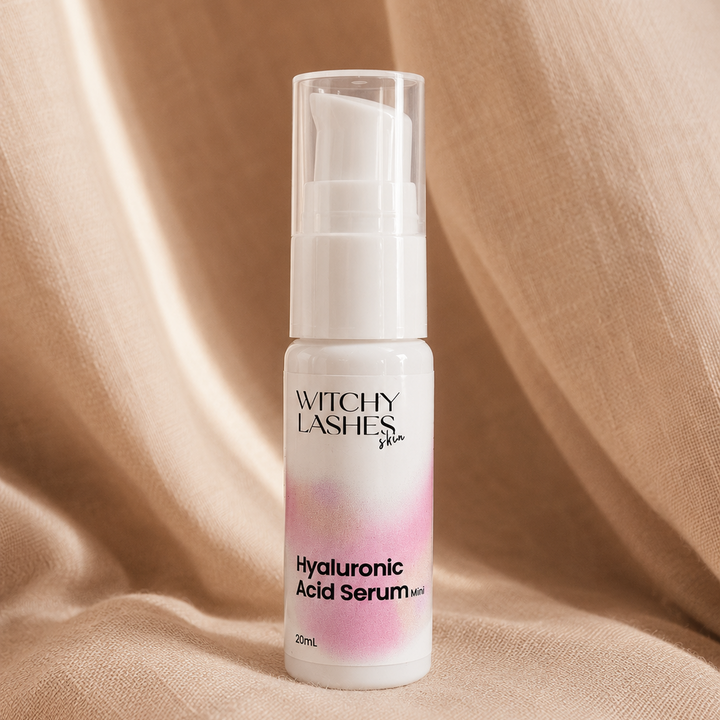
This sounds like a small detail. The difference between applying hyaluronic acid to damp skin and applying it to dry skin is the difference between skin that feels hydrated and comfortable, and skin that feels a little tight no matter what you put on it. It is also the reason we built Witchy's Hyaluronic Acid Serum as a deliberately minimal formula: purified water, plant-based hyaluronic acid, and a touch of natural preservation, with no fragrance and no actives beyond the hyaluronic acid itself, so it can do this one job well on a baseline that may already be more reactive than it used to be.
In practice, the routine that works is: cleanse gently with cool to lukewarm water, pat your face with a soft towel until it is no longer dripping but still slightly damp, press in a few drops of the serum within sixty seconds, wait about thirty seconds, then seal with an oil or moisturiser before the surface fully dries. Do not rub the serum in; pressing it into damp skin is enough. If your skin has become reactive, a simple cream or oil-based cleanser is usually a gentler starting point than a foaming one, since foaming cleansers strip the same lipid layer a perimenopausal barrier is already producing less of.
Many women notice a shift in the comfort of their skin within the first week of using a hyaluronic acid serum this way, on damp skin, twice a day. Skin feels less tight, less drawn, slightly plumper. Visible change in the appearance of fine lines and texture is usually a slower curve, with clearer change at the four to eight week mark. A more hydrated baseline also tends to mean stronger tolerance for the calming oil on top, and for the gentle vitamin A on retinoid evenings, which is why hydration is the step most women add first.
What hyaluronic acid will not do is pretend the years have not happened. It will not refill collagen that has reduced, and it will not solve perimenopausal acne on its own. What it will do is hold water in the upper layer of your skin and give the rest of your routine, the calming oil and the gentle vitamin A, a properly hydrated foundation to build on.
Your skin barrier in perimenopause
Your skin barrier, the outermost layer known as the stratum corneum, has one simple job: keep water in, and keep irritants out. Its structure is often described as brickwork. Skin cells are the bricks; a lipid layer of ceramides, cholesterol and fatty acids is the mortar holding them together.
In perimenopause the barrier does not fall apart, but it does change. Lipid production becomes less consistent as oestrogen fluctuates. A 2022 paper in Scientific Reports (Kao et al., 2022) found measurable changes in the ratio of long-chain to short-chain ceramides in the stratum corneum through menopause, with consequences for how well the lipid mortar holds together. A 2025 study in Skin Research and Technology (Nikoletić et al., 2025) measured barrier function across the menopause transition and confirmed increases in transepidermal water loss, meaning skin loses more water through the surface than it used to.
Cell turnover also slows through this transition, which means a barrier that has been disrupted, by a harsh cleanser or a new active, takes longer to recover than it once did. This is why a product you have used comfortably for years can suddenly sting. The product has not changed. The surface meeting it has. Active ingredients, fragrance and surfactants all penetrate faster and deeper into a more permeable barrier, and the cumulative load of several products used together matters more than it used to.
Common signs the barrier has become disrupted include skin that feels tight straight after cleansing, stinging or burning from products that previously felt fine, persistent dehydration that does not resolve with moisturiser, redness or flushing that flares easily, and slower recovery after sun or climate exposure. If several of these sound familiar, the calming-first approach below is the right place to start, rather than adding something new to address each symptom individually.
A 2021 review confirmed that endogenous hyaluronic acid synthesis declines through perimenopause and into menopause, reducing the skin's own capacity to hold water.
Lephart and Naftolin, Dermatology and Therapy, 2021
Barrier support is straightforward, even if it asks for patience: water in, water held, disruption reduced. Hyaluronic acid on damp skin puts water back in the upper layer. A facial oil with a compatible fatty acid profile, layered a few minutes later, seals that water in and supports the lipid layer directly. And the disruption side means pausing what is taxing a reactive barrier: foaming cleansers, heavy fragrance, and stacking too many actives at once.
The most disorienting part of perimenopausal barrier change is that the products causing problems are often the ones you have used comfortably for years. Those products were calibrated for a different barrier. A foaming cleanser that briefly disrupted your skin at thirty-five and recovered within hours can leave the barrier disrupted for a day or two at forty-seven. Used every morning, the cumulative effect is a barrier that never quite returns to baseline. Climate amplifies this too: a more permeable barrier loses water faster in air-conditioning, dries out more in wind, and reacts more to UV exposure than it used to.
Recovery is slower than it is in younger skin. For an actively reactive barrier (stinging, tight, flushing), expect two to four weeks of a calm, consistent routine before things settle. For barriers disrupted over years, three to six months is a more realistic timeline before the baseline genuinely shifts. Adding more products or stronger actives lengthens recovery, it does not shorten it. If products you have used and loved for years have started stinging, our piece on why products you used to love now sting goes deeper into rebuilding tolerance.
What is the best skincare for perimenopause?
The routine that holds up in perimenopause is shorter, gentler and more consistent than the one that suited your skin in your thirties. It does three specific jobs: hydration, calming and barrier support, and gentle renewal, and the Witchy three-product routine maps to those jobs directly.
Hydration: the Hyaluronic Acid Serum, applied to damp skin twice a day, replaces the water-binding work your skin's own hyaluronic acid is doing less of (see above).
Calming and seal: the Blue Tansy Calming Facial Oil is layered a few minutes after the serum. Its fatty acid profile supports the barrier's lipid layer, and it contains blue tansy essential oil, rich in chamazulene, which has documented antioxidant activity in laboratory research (Slon et al., 2024). Applied over the hyaluronic acid serum, it seals the water in and supports a calmer baseline.

Gentle renewal: the Retinyl Renewal Oil uses retinyl palmitate, the gentlest cosmetic form of vitamin A, formulated for a barrier that has become more reactive. Retinoids, once converted to retinoic acid in the skin, are understood to support cell turnover and the appearance of texture and tone (Sorg et al., 2006; Mukherjee et al., 2006). Stronger retinoids that worked well at thirty-two often become too much at forty-seven; retinyl palmitate is the form most likely to be tolerated consistently, used two to four nights a week rather than nightly. A retinoid used three or four nights a week for a year does more for the appearance of skin than a stronger one used nightly for three weeks before it is abandoned.

Every morning: gentle cleanse with cool to lukewarm water. Pat skin damp, not dry. Press in Hyaluronic Acid Serum within sixty seconds. Wait about thirty seconds. Press in Blue Tansy Calming Facial Oil. Finish with mineral sunscreen, generously, every day.
Retinoid evenings (two to four per week, building slowly): cleanse, pat damp, Hyaluronic Acid Serum within sixty seconds, wait about thirty seconds, then two to three drops of Retinyl Renewal Oil. Nothing else layered on top: no other actives, no vitamin C, no acids.
Calming evenings (the rest of the week): cleanse, pat damp, Hyaluronic Acid Serum, wait about thirty seconds, then three to four drops of Blue Tansy Calming Facial Oil.
If you are recalibrating an existing routine rather than starting fresh, add the Hyaluronic Acid Serum first and run it alone for two to three weeks. Add the Blue Tansy Calming Facial Oil next and give that combination another two to three weeks before introducing the Retinyl Renewal Oil at twice a week, evening only. If your skin is currently reactive, pause most of your existing routine and run only the hydration and calming steps, with mineral sunscreen in the morning, for two to four weeks before adding anything else back.
The realistic timeline: the hydration step produces the first noticeable change within one to two weeks, skin feeling less tight and slightly plumper. The calming step settles in over weeks three and four. By months two and three the routine becomes second nature and the retinoid is producing gentle changes accumulating in the upper skin layers. The accumulated changes from retinyl palmitate become visible from around months four to six, with the biggest cumulative shift by months six to twelve.
The instinct in perimenopause is often to add more: more products, more actives, more steps. What tends to help more is fewer products, applied consistently. Three good ingredients working together, with a calming layer holding the routine together, generally do more for the appearance of perimenopausal skin than ten products applied haphazardly.
If you already have a skincare routine you like and simply want to layer in perimenopause support, the Hyaluronic Acid Serum is generally the easiest addition, since it suits almost any existing routine and is usually added first, straight after cleansing. The Blue Tansy Calming Facial Oil works well alongside most routines except ones that already include several heavy seal products. The Retinyl Renewal Oil is the one exception: it should not be stacked with another retinoid. If you are currently using a stronger retinol or prescription retinoid, transition off it before introducing the Retinyl Renewal Oil, rather than layering the two together.
Which moisturiser for perimenopause skin?
Many women ask whether they still need a separate moisturiser once a hyaluronic acid serum and a facial oil are part of the routine. For most perimenopausal skin, that two-step combination, a humectant on damp skin followed by an oil layered on top, does the job a traditional moisturiser is built to do: water in, water held. If your skin still feels tight after that combination, a simple, fragrance-free moisturiser can sit between the two, applied while skin is still damp from the serum.
Look for something short on ingredients rather than long: a humectant like glycerin or hyaluronic acid, a few supportive lipids such as squalane or plant oils, and little else. Ceramides are worth looking for too, since they mirror the lipids your barrier is producing less of, though they are not essential if your oil step is already doing that job. Heavier, richly fragranced creams are usually the first thing worth removing from a reactive perimenopausal routine, not adding to it.
If your skin is genuinely very dry, particularly overnight or through a cold snap, a slightly richer, fragrance-free night cream layered over the hyaluronic acid serum is reasonable. The principle stays the same either way: hydration first, on damp skin, then something to seal it in. The goal is a moisturiser that supports the barrier quietly, not one that tries to do everything at once.
Oily or breakout-prone skin in perimenopause
It is common, and often confusing, to have skin that feels drier overall while still breaking out, particularly along the jawline. As oestrogen and androgens shift in balance through perimenopause, sebum production can become uneven: drier through the cheeks and forehead, oilier and more congested along the jaw and chin. The instinct is often to treat this like oily skin from your twenties, with stronger cleansers and more exfoliation, which usually adds to the reactivity rather than solving it.
The calming, barrier-first approach above still applies here. Harsh spot treatments and aggressive exfoliation tend to disrupt the barrier further, which often makes both the dryness and the breakouts worse rather than better. Any post-breakout marks are usually best left to fade with a consistent, gentle routine and daily sunscreen rather than targeted separately, since new pigmentation and post-inflammatory marks respond to the same barrier-supportive approach. For a closer look at what drives perimenopausal jawline breakouts and how to work with them without over-stripping your skin, see our piece on perimenopause acne on the jawline.
Perimenopause skin care products: what to look for and what to skip
Look for:
- A humectant serum, hyaluronic acid or glycerin based, applied to damp skin, to replace the water-binding your own skin is doing less of
- A facial oil or light moisturiser with a compatible fatty acid profile, to seal hydration in and support the barrier's lipid layer
- Retinyl palmitate rather than stronger retinoids, if vitamin A has become hard to tolerate, since it is generally better suited to a more reactive barrier
- Mineral sunscreen (zinc oxide, titanium dioxide) as a daily non-negotiable, particularly if pigmentation is part of the picture
- Short ingredient lists, particularly for anything used daily, so a reaction is easy to trace back to its cause
Skip, or use sparingly:
- Foaming or stripping cleansers, which remove the lipid layer a perimenopausal barrier is already producing less of
- Heavily fragranced products, since a more permeable barrier lets fragrance compounds reach deeper and trigger reactions they did not previously cause
- High-concentration vitamin C or glycolic acid layered on the same evening as a retinoid, which compounds disruption rather than adding benefit
- Multiple actives stacked in one routine, one of the more common reasons perimenopausal skin tips into reactivity
- Alcohol-based toners and other quick-fix steps that promise brightness or tightening but tend to strip further
- Adding new products faster than your skin can tell you how it feels about the last one
There is no single ingredient perimenopausal skin must avoid across the board. The pattern that helps most is fewer products, applied consistently, with enough time built in between changes for your skin to tell you what is actually working. If you are unsure whether something in your current routine is the culprit behind new reactivity, pausing it for two to four weeks and watching what changes is usually more informative than adding something else on top to compensate. Introduce one product at a time, roughly two to three weeks apart, so that if your skin does react, you know exactly what caused it rather than having to unpick a routine of five new things at once.
Go deeper
Perimenopause touches more of your skin, and your life, than any single article can cover. Sleep, stress, hormones and skin are more connected than most routines account for, and some of the changes above (jawline breakouts, new pigmentation, sudden sensitivity) genuinely warrant their own closer look. These go further into the specific changes above.
-
The retinol that worked at 32 doesn't work at 47 (and why)
The fuller case for recalibrating vitamin A in perimenopause, not stopping it.
-
Perimenopause acne on the jawline: what's driving it
The hormonal pattern behind jawline breakouts, and how to work with them.
-
Why new pigmentation appears in perimenopause (and the calm approach)
Melasma, sun spots and uneven tone, and what supports the appearance of even skin.
-
Why products you used to love now sting
Rebuilding tolerance after a reactive stretch, step by step.
-
Why perimenopause sleep disruption shows on your face
The sleep and cortisol connection, and what to do about it.
-
Skin changes in your forties: what's hormonal and what's not
Separating perimenopause from ordinary ageing.
-
Menopause skincare in Australia: a calm, practical guide
If you are past perimenopause, this is where the story picks up next.
Common questions
What are the most common perimenopause skin changes?
The most common perimenopause skin changes are drier, less plump-feeling skin from declining collagen and hyaluronic acid, a more reactive barrier that stings at products it used to tolerate, uneven sebum (drier overall with oilier jawline patches), and new or worsening pigmentation. All are linked to fluctuating, then declining, oestrogen, and none of them mean your skin has failed.
What is the best skin care for perimenopause?
A short, gentle, consistent routine built around three jobs: hydration (a hyaluronic acid serum on damp skin), calming and barrier support (a facial oil layered on top), and gentle renewal (retinyl palmitate two to four nights a week). Most perimenopausal skin does better with fewer products used consistently than with a longer, more active-heavy routine.
What is a good perimenopause moisturiser?
A perimenopause moisturiser is usually best kept simple: a humectant like hyaluronic acid or glycerin, a few supportive lipids, fragrance-free. For many women, a hydrating serum on damp skin plus a facial oil sealed on top does the job of a traditional moisturiser without adding an extra product.
Is retinol still ok in perimenopause?
Often, but the form matters more than the fact of using it. Stronger retinoids that suited your skin in your thirties frequently become too much for a more reactive perimenopausal barrier. Retinyl palmitate, the gentlest cosmetic form of vitamin A, is generally better tolerated, used two to four nights a week on damp skin under a hyaluronic acid serum, and built up slowly.
When does perimenopause skin settle?
There is no fixed timeline, because perimenopause itself typically runs four to eight years before periods stop. Skin generally becomes more predictable, though not necessarily calmer, once oestrogen settles into its lower post-menopausal steady state. In the meantime, a barrier-supportive routine reduces how reactive skin feels along the way: most women notice a calmer baseline within four to eight weeks of consistent hydration and calming support.
Do I need different skincare for perimenopause than I used in my thirties?
Probably yes. The routine that suited your skin in your thirties was calibrated for a different barrier, a different hydration baseline and a different tolerance for active ingredients. As oestrogen fluctuates and declines, the routine that holds up is generally gentler, more hydrating and more patient.
Can I use hyaluronic acid serum with retinol in perimenopause?
Yes, and the combination is worth building into your routine rather than avoiding. On retinoid evenings, apply the hyaluronic acid serum on damp skin first, wait about thirty seconds, then apply the retinol or retinyl palmitate over the top. The hyaluronic acid replaces water in the upper skin layer that a retinoid pathway can sometimes pull out, which generally makes vitamin A more comfortable to sustain over months.
References
- Davis, S.R., et al. (2025). The Australian Women's Midlife Years Study. The Lancet Diabetes and Endocrinology.
- Brincat, M., et al. (1987). A study of the decrease of skin collagen content, skin thickness, and bone mass in the postmenopausal woman. Obstetrics and Gynecology, 70(6), 840–845.
- Lephart, E.D., and Naftolin, F. (2021). Menopause and the skin: old favourites and new innovations in cosmeceuticals for oestrogen-deficient skin. Dermatology and Therapy, 11(1), 53–69.
- Kao, et al. (2022). Ceramide profile changes in the stratum corneum through menopause. Scientific Reports.
- Nikoletić, K., et al. (2025). Skin barrier function across the menopause transition. Skin Research and Technology.
- Bravo, B., et al. (2022). Reviewing the dermatological uses of topical hyaluronic acid. Journal of Cosmetic Dermatology.
- Slon, K., et al. (2024). Chamazulene: antioxidant and biological activity. Molecules.
- Sorg, O., et al. (2006). Retinoids in cosmetics and dermatology. Dermatologic Therapy, 19(5), 289–296.
- Mukherjee, S., et al. (2006). Retinoids in the treatment of skin ageing: an overview of clinical efficacy and safety. Clinical Interventions in Aging, 1(4), 327–348.
- Piérard-Franchimont, C., et al. (2002). Sebaceous follicle activity and menopause. Dermatology.

